

Closing a Project
The purpose of the Closing a Project process (CP) is to provide a definitive end point confirming acceptance of project products, recognise that objectives defined in the PID have been achieved, and prevent aimless continuation of operations.
Objectives
| Objective |
|---|
| Confirm user acceptance of project products |
| Ensure the business can support the products after project closure |
| Review project performance against the baseline |
| Evaluate benefits already realised and update the Benefits Management Approach to include post-project benefit reviews |
| Ensure means to address unresolved issues and risks through Follow-on Action Recommendations |
| Ensure project closure is carried out in an orderly manner and the project has not simply been abandoned (in the case of premature closure) |
Benefits of a Definitive Project End
Formally closing the project produces the following effects:
- Recognition of success: All parties can recognise that objectives have been met
- Transfer of responsibility: Ownership of project products is formally transferred to operations, and the project management team is released from responsibilities and can be disbanded
- Cost cessation: Project costs can be stopped from that point forward
- Learning opportunity: Unachieved goals can be identified and organised as challenges for future efforts
Key Implementation Points
- Ensuring finitude: Essential to maintaining the project’s character as an activity with a beginning and an end
- Handling premature closure: Provides a framework for orderly closure even when a project is cut short due to Business Case failure, etc.
- Planned closure: Closure activities should be incorporated in advance as part of the final management stage plan
- Follow-on Action Recommendations: Document specific actions to be taken after closure
Activities
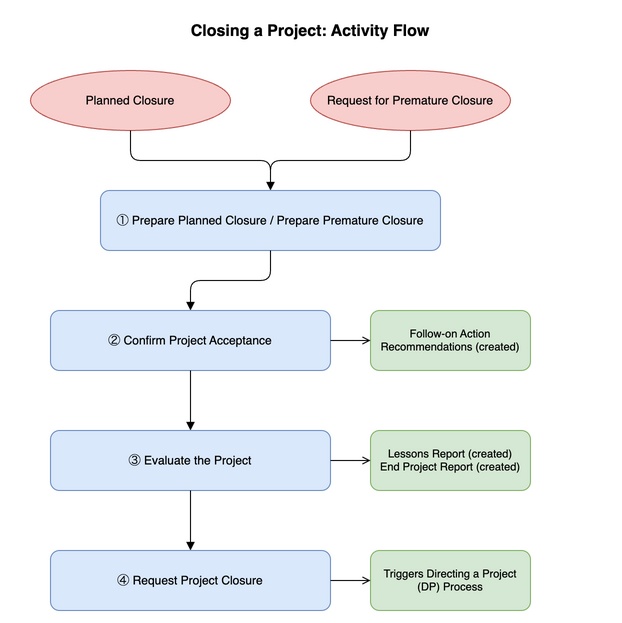
| Input | Activity | Output |
|---|---|---|
| Approaching project end (trigger), Project Log, PID, Business Case, Project Plan | Prepare Planned Closure | Project Log (updated), Project Plan (updated as needed), Benefits Management Approach (updated as needed), Lessons Report (created), End Project Report (created) |
| Same as above | Confirm Project Acceptance | Same as above |
| Same as above | Evaluate the Project | Same as above |
| Same as above | Request Project Closure | Same as above |
| Request for premature closure (trigger), Project Log, PID, Business Case, Project Plan | Prepare Premature Closure | Project Log (updated), Project Plan (updated as needed), Benefits Management Approach (updated as needed), Lessons Report (created), End Project Report (created) |
| Same as above | Confirm Project Acceptance | Same as above |
| Same as above | Evaluate the Project | Same as above |
| Same as above | Request Project Closure | Same as above |
Activity Details
1. Prepare Planned Closure
Once it is confirmed that the project can be closed, prepare to issue a closure recommendation to the Project Board.
Recommended actions:
- Use the Communication Management Approach to identify organisations and parties that need to be informed of project closure
- Also consider communication activities for public relations and marketing opportunities
- Close the Project Log
- Ensure project information is stored securely (in accordance with the Digital and Data Management Approach)
- Prepare a draft project closure notification for review by the Project Board
2. Prepare Premature Closure
In some situations the Project Board may instruct the Project Manager to end the project early.
In this case the Project Manager’s role is to:
- Recover the value created in the project to date, rather than simply abandoning in-progress work
- Show the business the losses caused by the project’s discontinuation
Recommended actions:
- Update the Project Log (and Issue Report as needed) to record the request for premature closure
- Update the Project Plan to reflect actuals in the final stage
- Evaluate and classify product status from the following perspectives:
- Approved, in development, conditionally approved, not started
- Those requiring safeguarding (protective measures or data protection)
- Those that may be repurposed or reused by other projects
- Agree on means for recovering completed and in-progress products (requires Project Board consultation)
- Creation of an Exception Plan may be required (for additional work such as completing products useful to other projects or ensuring their safety)
- Notify the business of the possibility that resources and personnel may be released early, and seek approval
3. Confirm Project Acceptance
Confirm the formal transfer of ownership of project products from the project management team to the operational and maintenance environment.
Forms of transfer:
- Carried out as a single release at the end of the project
- Depending on the project approach, may be split into multiple releases through phased delivery
- In the case of premature closure: ownership of products that are approved but not yet delivered is transferred to users in accordance with Project Board guidance
Recommended actions:
- Consult with the project management team and prepare Follow-on Action Recommendations regarding incomplete work, issues, and risks relating to project products
- Individual Follow-on Action Recommendations may be created for each project product or component, or for specific user groups (HR, Finance, Operations, etc.)
- Confirm that the Benefits Management Approach records post-project closure activities
- Review the Project Initiation Documentation to confirm how products are to be provided to those who will manage them
Important: Post-project benefit reviews are not themselves project activities. What is included as a project activity is planning for such benefit reviews to take place.
4. Evaluate the Project
Successful organisations use learning from project experience.
Objective: Assess how successful the project was — or, in the case of premature closure, assess the project and the reasons for premature closure.
Recommended actions:
- Review the original project intent as defined in the PID, baselined and agreed during the initiation stage
- Review approved changes as defined in the latest versions of PID components
- Consult with the project management team and prepare the End Project Report
- Review the Project Log, identify lessons applicable to future projects, and document them in the Project Lessons Report
5. Request Project Closure
The Project Manager contacts the Project Board to request project closure.
Recommended actions:
- Brief the Project Board on project performance and confirm readiness to close
- Highlight any areas of conditional approval for off-specifications
- Request the Project Board to authorise project closure
- Suggest to the Project Board celebrating the project’s success and expressing gratitude to all involved parties
Responsibilities
| Activity | Business Layer | Project Executive | Senior User | Senior Supplier | Project Manager |
|---|---|---|---|---|---|
| Prepare Planned Closure | — | A | C | C | R |
| Prepare Premature Closure | — | A | C | C | R |
| Confirm Project Acceptance | — | A | C | C | R |
| Evaluate the Project | — | A | C | C | R |
| Request Project Closure | I | A | C | C | R |
R = Responsible, A = Accountable, C = Consulted, I = Informed
Applying Practices to the Process
| Practice | Application to Closing a Project |
|---|---|
| Business Case | Update with actuals (cost, benefits) and revise unrealised benefit projections. Review and update the Benefits Management Approach |
| Organising | Evaluate team performance and wellbeing and record as lessons. Confirm requirements of various management approaches; disband the project management team and complete offboarding |
| Plans | Compare and analyse plans against actuals; analyse overall project performance |
| Quality | Confirm in the Quality Register that all quality activities up to the final stage have been completed. Close the Quality Register |
| Risk | Organise final stage risks; transfer unresolved residual risks to the business. Close the Risk Register |
| Issues | Organise unresolved issues; identify Follow-on Action Recommendations for the business to take over. Close the Issue Register |
| Progress | Confirm delivery of all products via the Product Register and close the register. Issue the End Project Report. Close the Daily Log and Lessons Log |
If you enjoyed this, leave a comment~