

Plans
The purpose of the plans practice is to facilitate communication and control by defining the products to be delivered (the ‘what’) and the means to deliver them (the ‘who’, the ‘how’, the ‘where’, and estimates of the ‘when’ and for ‘how much’) to satisfy the project business case (the ‘why’).
Definition: Plan A proposal that outlines the what, where, when, how, and who of the project as a whole (or a subset of its activities). In PRINCE2, there are the following types of plan: project plan, stage plan, team plan, and exception plan.
7.1 The Dual Purpose of Plans
Plans Enable Understanding and Communication
Plans integrate three perspectives:
- The user’s expectations of the products to be delivered and the benefits to be realized
- The project management team’s assessment of the most effective approach to meet these expectations
- The business support for the project, including the commitment of funding, people, and resources
Plans enable the project management team to assess and understand:
- The why: the user’s driving requirements and the benefits they expect to realize
- The what: the products to be delivered and their associated acceptance criteria and quality specifications
- The how: the delivery method and any constraints
- The when: the sequence and estimated duration of delivery activities
- The where: the locations and facilities involved in delivery and acceptance
- The who: the required skills and responsibilities of the project team and how they will be organized
- The how much: the estimated cost of the agreed products and the associated delivery and management activities
Plans Enable Control
Definition: Scope The sum of the product, delivery, and management activities represented by an approved plan and its product descriptions and work package descriptions.
An approved and baselined project plan represents the agreed scope of the project. A clear understanding of what is and what is not within the approved project scope is essential to avoid uncontrolled changes, often referred to as scope creep.
7.2 Guidance for Effective Planning
7.2.1 Planning Horizon
Plans are always based on estimates. The PRINCE2 principle of manage by stages addresses the need to keep plans within reasonable planning horizons. A PRINCE2 project has:
- A project plan: a high-level description of how and when the project’s objectives are to be achieved
- A stage plan: a detailed document for the current stage based on more precise estimates achievable within the planning horizon
7.2.2 Levels of Plans
| Plan Type | Definition |
|---|---|
| Project plan | A high-level plan showing the major products of the project and when, how, and at what cost they will be delivered |
| Stage plan | A detailed plan used as the basis for project management control throughout a stage |
| Team plan | A plan used as the basis for organizing and controlling the work of a team when executing a work package. Team plans are optional in PRINCE2 |
| Exception plan | A plan that follows an exception report and explains how the project will respond to the exception within the stage |
Relationship between plans:
Project mandate/business plan → Project plan → Subsequent stage plans → Team plans
                              ↘ Initiation stage plan
                                              ↘ Exception plans (as necessary)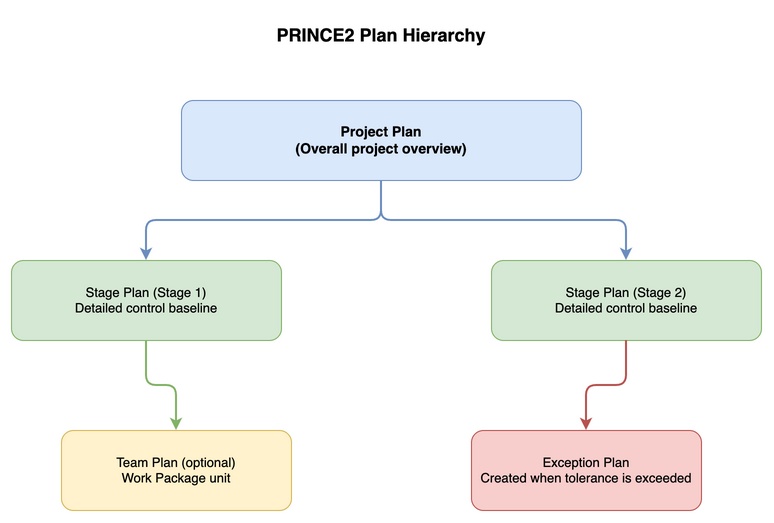
7.2.3 Stages
Determining how to divide the project into stages is a matter of balancing:
- The delivery method (iterative-incremental or linear-sequential)
- The sequence of delivery activities
- The type of people and resources involved
- The number and timing of key decision points
- The amount of risk the project can manage
- How far ahead in the project it is sensible to plan
The number of stages: A greater number of stages increases the degree of control, but every stage boundary requires effort to manage.
The length of stages is determined by:
- The level of complexity: high dependencies may benefit from shorter stages
- The level of risk: stage breaks at key points where risks can be reviewed before major resource commitment
- The planning horizon: significant uncertainty benefits from shorter stages
- Appropriate decision points: stage boundaries aligned with critical decisions
- Alignment with programme activities: programme may require alignment with tranche boundaries
PRINCE2 stages do not overlap — they partition the project by introducing stop-go decision points, enabling the project board to review progress and confirm continued business justification.
7.2.4 Tolerances in Planning
PRINCE2 includes tolerances for benefits, time, cost, quality, scope, risks, and sustainability:
| Tolerance Type | Definition |
|---|---|
| Time tolerance | The permissible deviation in a plan’s time that is allowed before the deviation needs to be escalated to the next level of management |
| Cost tolerance | The permissible deviation in a plan’s cost that is allowed before it needs to be escalated to the next level of management |
| Scope tolerance | The permissible deviation in a plan’s scope that is allowed before it needs to be escalated to the next level of management |
7.2.5 Product-Based Planning
Definition: Product-based planning The PRINCE2 technique leads to a plan based on the creation and delivery of the required products.
Focus on products is a principle of PRINCE2. Benefits:
- Helps avoid activities that do not contribute substantively to the required outputs
- Helps the project manager know where to start when developing plans
- Reduces the risk of scope being neglected or overlooked
- Helps exception plans focus on resolving the exception with minimal impact on cost and schedule
7.3 PRINCE2 Planning Technique
7.3.1 Planning Technique Steps (Six Steps)
| Step | Description |
|---|---|
| 1. Defining and analysing products | Write project product description → Create product breakdown structure → Write product descriptions → Create product flow diagram |
| 2. Organizing work packages | Identify work packages and determine dependencies |
| 3. Preparing estimates | Estimate people, resources, activity duration, costs, benefits, and risks |
| 4. Preparing a schedule | Sequence, interrelationships, and duration of work packages and tasks |
| 5. Preparing the budget | Calculate plan costs including risk budget and change budget |
| 6. Documenting the plan | Analyse risks, create narrative document explaining the plan |
Defining and Analysing Products in Detail
Project product description
A description of the project’s major products or outcomes, including the user’s quality expectations, together with the acceptance criteria and acceptance methods for the project.
Product breakdown structure
A hierarchy of all the products to be produced during a plan.
Each product is divided into its component elements in a hierarchical manner, and the requirements for those elements are collected.
Product flow diagram
A diagram showing the sequence of production and interdependencies of the products listed in a product breakdown structure.
Dependencies
A dependency means that one product is dependent on another.
- Internal dependency: between two products of a project — the project team has control
- External dependency: between a project product and a product or activity outside the scope of the project — the project team does not have complete control
7.3.2 Supporting Techniques
Prioritizing methods:
- Categorizing criteria as must-have, should-have, could-have, or won’t have (MoSCoW)
- A product backlog approach explaining the sequence in which features will be made available
- Pairwise comparison to understand preferences between criteria
- The Kano model (delighters, performance features, and essential features)
- Eisenhower matrices (importance vs. urgency or value vs. ease of implementation)
Scheduling tools:
- Gantt chart: graphical representation of task duration against time progression
- Spreadsheet: listing work packages and tasks with corresponding timelines
- Product checklist: list of major products and key delivery dates
- Activity flow board: shows progress of each product through development/delivery (Kanban)
Estimating techniques:
- Top-down: costs, durations, and effort estimated at a high level of confidence, then allocated down
- Bottom-up: estimates made at the lowest defined level, then aggregated
- Comparative: based on similar projects or publicly available market information
- Parametric: using values in the project (numbers of units, size) to estimate
- Data analysis: descriptive analysis (characteristics of tasks) and predictive analysis (likely outcomes)
- Subject matter expertise: consensus-based techniques such as Delphi and planning poker
7.4 Applying the Practice
7.4.1 Organizational Context
- Project plans are typically affected by the organizational context, including policies, procedures, and support
- The programme management team may play a major supporting role, even leading the planning for its projects
- The programme may define a standard set of stages that projects within it must follow
7.4.2 Commercial Context
- For projects in a commercial context, the role of suppliers is an important consideration
- Agreements should ensure supplier plans provide clear traceability to the user’s project plan
- Agreements should describe how plans are prepared and what inspection and audit rights the user has
- Plans should include procurement-related milestones aligned to each stage
7.4.3 Delivery Method
- Linear-sequential projects: most planning work done upfront during starting up and initiating processes; comparable projects help establish planning horizons and high-confidence estimates
- Iterative-incremental projects: focus on how much can be produced in a fixed time period (e.g., sprints or timeboxes); aim to quickly deliver initial products and iteratively improve them
7.5 Management Products
Key planning management products include:
- Project product description: for project plan only, created during starting up a project
- Product descriptions: describe required products in more detail during initiating a project
- Work package descriptions: agreements between project manager and team manager, documenting all dependencies
- Schedule and budget: may be maintained in separate systems or files
- Narrative document: explains the plan at a high level, identifying dependencies, proposed tolerances, monitoring and control requirements, budgets, key risks, and assumptions
If you enjoyed this, leave a comment~