

People
The purpose of a project is to deliver change, which will affect people in their business as usual (BAU) activities, routines, and responsibilities. In PRINCE2, ‘people’ covers those working on a project and the relationships between them, as well as those impacted by a project. People are central to the method.
Key Definitions
| Term | Definition |
|---|---|
| Organizational ecosystem | The internal elements of an organization (including staff, board, owners, and other stakeholders) together with the organization’s external relationships such as customers, partners, suppliers, regulators, and competitors |
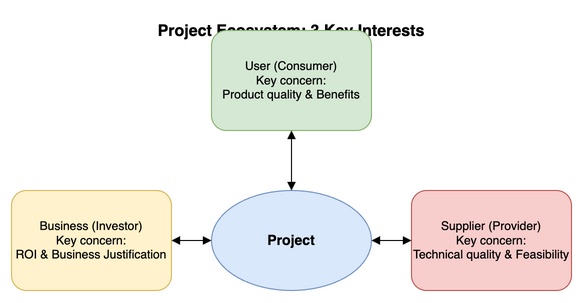
| Project ecosystem | Those elements of the business involved in or directly impacted by the project and the associated users and suppliers |
| Stakeholder | Any individual, group, or organization that can affect or be affected by (or perceives itself to be affected by) the project |
| Change management | The means by which an organization transitions from the current state to the target state |
| Culture | The set of shared attitudes, values, goals, and ways of working that characterize a group of people |
Three People-Focused Core Activities
        Leading successful change
                    ↕
   Communication ← People central → Leading successful teams
                   to the method
1. Leading Successful Change
Projects Require Change Management
All projects result in a change in how people, organizations, and systems operate from the current state to a future target state that incorporates the use of the project products.
Management product: Change management approach (part of project initiation documentation)
| Content Element | Description |
|---|---|
| Scope | What changes will be delivered by the project; any exclusions |
| Change states | Description of current, interim, target states |
| State characteristics | For each state, highlighting those that are changing: routines, practices, process, culture, responsibilities, structure, capabilities |
| Enabling activities | Before transition, during transition, after transition; consultation, trials, training, and helpline |
| Resources | For the enabling activities |
| Responsibilities | For the enabling activities |
| Supporting tools and techniques | For the enabling activities; for example, modelling |
Stakeholders
Key stakeholders are the key influencers, who may be:
- Senior executives
- Those found in the user, supplier, or wider operational communities undertaking day-to-day tasks and decision-making
- Those who can be identified by considering the bottlenecks where information, knowledge, and money flow across interfaces
- Those who can shape the perception of the majority within the project ecosystem
- The people the project management team needs to work closest with to ensure the success of the project
Culture
- A shared understanding of the project developed with key influencers must be captured as part of the project brief
- Based on the shared understanding, establish ways of working to ensure all impacted areas of the organizational ecosystem are appropriately involved
- Defined ways of working should remain aligned with how people are actually working; persistent non-compliance with project processes is often a leading indicator that the agreed ways of working have become unaligned with the emerging project culture
2. Leading Successful Teams
Key Definitions
| Term | Definition |
|---|---|
| Collaboration | People from across the project ecosystem working together to achieve the project’s objectives |
| Co-creation | A specific form of collaboration involving users and key influencers in the design of products and agreed ways of working to ensure they are adopted by the project and organizational ecosystems |
| Leadership | Motivating people to achieve a project’s objectives. On projects, this is best done through collaboration across the project ecosystem, persuading, influencing, and co-creating with a focus on managing key relationships and seeking regular feedback |
| Management | Instructing the execution of tasks in line with agreed ways of working. Co-creating ways of working with project team members significantly improves people’s willingness to be managed in line with them |
Key Awareness for Leading Project Teams
- Although a project manager has formal authority within tolerances set by the project board, the actual power structure in a project does not always reflect what has been formally agreed
- Project managers often rely on their ability to influence and motivate people through aligned interests and relational skills
- PRINCE2 defines roles that might not align with a person’s job title
- Team members often have competing priorities for their time and attention
Building Effective Teams
- An effective team requires a diverse set of capabilities, competencies, and perspectives that match the requirements of the project
- Psychological safety: team members feel accepted, respected, and able to express diverse viewpoints without fear of negative consequences
- PRINCE2 supports building effective teams through:
- Project plan: Creates a clear sense of purpose
- Project management team structure and role descriptions: Explains structure, roles, responsibilities, and relationships
- Communication management approach: Explains how team members will engage with and support each other
- Project initiation documentation: Explains agreed ways of working
- Product-based planning: Places emphasis on getting agreement on what will meet user needs
Bringing the Team Together (Social Cohesion)
Social cohesion is developed by:
- People meeting in a purposeful way on a regular basis and building trust across organizational or project silos
- Considering how key relationships will be developed and maintained over the project length
- For virtual teams: syncing co-location days, allowing time for less structured conversations online, holding ‘away days’
3. Communication
PRINCE2 addresses communication in a communication management approach.
Management product: Communication management approach (part of project initiation documentation)
| Content Element | Description |
|---|---|
| Scope | Describes what communication will be managed by the project |
| Stakeholder analysis | Identification and analysis of those impacted by the outcome of a project or by the process of delivering the project |
| Communications schedule and procedures | For each stakeholder group: purpose, frequency, channels/format, messaging |
| Responsibilities | For the communication activities |
| Resources | For the communications activities |
| Standards | Any standards that apply to communication activities |
A communication management approach is equally about listening as it is about broadcasting. It seeks to understand the perceptions and concerns within the project ecosystem so they can be addressed before they become more significant risks.
Team Type and Communication
- Co-located teams: Information tends to be shared organically; focus on monitoring free information flow and reconnecting disconnected members
- Remote teams: A more deliberate and structured approach required; build in time for unstructured listening
- Hybrid teams: Must ensure the project does not develop separate groups who are more or less involved because of location
People and PRINCE2 Principles
| Principle | People Factor |
|---|---|
| Ensure continued business justification | Business justification needs to satisfy all three project interests: user, business, and supplier; the communication management approach is a key enabler for ongoing business justification |
| Learn from experience | People factors such as behaviours, culture, and relationships are best learned through social learning |
| Manage by stages | Stage boundaries mark a change in influencers and key relationships; provide opportunity to review skills needed for next delivery stages |
| Manage by exception | Decisions should be made at the most local level where the knowledge resides; the extent of delegation depends on confidence and trust in key relationships |
| Focus on products | Co-creating products with business, user, and supplier communities unites their different perspectives |
| Tailor to suit the project context | Tailoring supports adapting PRINCE2 to the people and organizations involved rather than attempting to adapt them to the method |
If you enjoyed this, leave a comment~