

Principles
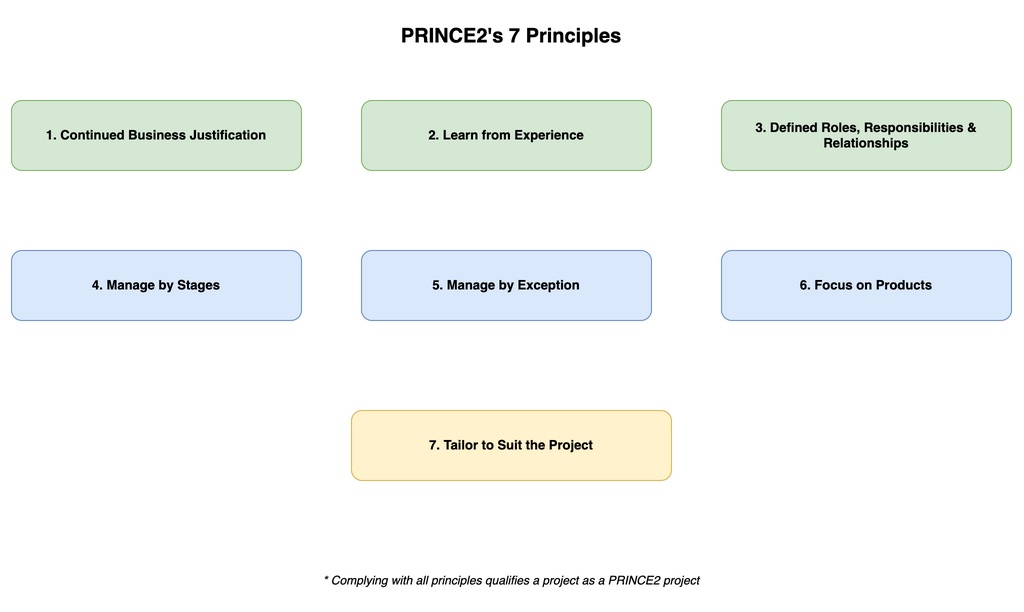
The PRINCE2 principles are the guiding obligations that determine whether the project is genuinely being managed using PRINCE2 and ensure effective application and tailoring of PRINCE2 to any project. All seven principles must be applied — if they are not, it is not a PRINCE2 project.
The Seven PRINCE2 Principles
| Principle | Key Message |
|---|---|
| 1. Ensure continued business justification | A PRINCE2 project has business justification sufficient to warrant investment to initiate the project and ongoing investment through to successful completion. If it does not, it should be stopped |
| 2. Learn from experience | A PRINCE2 project team actively seeks, records, and implements improvements as a result of relevant lessons learned from prior projects and throughout the life of the project |
| 3. Define roles, responsibilities, and relationships | A PRINCE2 project has defined and agreed roles and responsibilities within an organization structure that engages the business, user, and supplier stakeholder interests |
| 4. Manage by stages | A PRINCE2 project is planned, monitored, and controlled on a stage-by-stage basis |
| 5. Manage by exception | A PRINCE2 project establishes limits of delegated authority by defining tolerances for performance against its plans |
| 6. Focus on products | A PRINCE2 project focuses on the definition and delivery of products, in particular their user quality expectations and requirements |
| 7. Tailor to suit the project | PRINCE2 is applied and tailored to suit the project environment, size, complexity, importance, delivery method, team capability, and level of risk |
Principle Details
1. Ensure Continued Business Justification
There must be a justifiable reason for starting a project, and the justification must remain valid and be revalidated throughout the lifecycle.
- Business justification drives decision-making to ensure the project remains aligned with the benefits sought
- If continuing with the project can no longer be justified, it should be stopped in a controlled way
- After the project is completed, it should be reviewed to evaluate if the benefits have materialized
2. Learn from Experience
Learning from experience occurs throughout the lifecycle:
- When starting a project: Previous or similar projects should be reviewed to see if lessons could be applied
- As the project progresses: The project team should continue to learn; lessons should be included in relevant reports and reviews and at the end of each stage
- As the project closes: The project team should share the insights gained during the project
Lessons that are not used to improve the project, or future projects, are only ‘lessons identified’ and not actually ‘lessons learned’.
3. Define Roles, Responsibilities, and Relationships
- All projects have three primary stakeholders: the business, users, and suppliers
- The assignment of roles to individuals throughout the life of the project and their responsibilities must be clear, unambiguous, and accepted
- Projects must have an explicit project management team structure with defined and agreed roles and responsibilities
4. Manage by Stages
Definition: Stage The section of a project that the project manager is managing on behalf of the project board at any one time.
Every PRINCE2 project should have at least two stages: an initiation stage and one further stage.
Advantages of managing by stages:
- Enables adaptability to changes in the project or business context
- Provides review and decision points, giving the project board opportunities to assess the project’s viability
- Provides ability to ensure that key decisions are made prior to the detailed work needed to implement them
- Facilitates the principle of manage by exception by delegating authority to the project manager at each stage
5. Manage by Exception
Definition: Tolerance The permissible deviation above and below the plan’s target for benefits, cost, time, quality, scope, sustainability, and risk without needing to escalate the deviation to the next level of management. Tolerance is applied at project, stage, and team levels.
The seven aspects of a plan’s performance requiring tolerances to be defined:
| Performance Aspect | Tolerance Description |
|---|---|
| Benefits | The degree to which it is permissible to underdeliver or overdeliver benefits |
| Costs | The degree of permissible overspend or underspend against an agreed budget |
| Time | The degree to which it is permitted to deliver earlier or later than an agreed target completion date |
| Quality | How much something can vary from agreed acceptance criteria |
| Scope | Permissible variation of the plan’s products |
| Sustainability | The degree to which the project product or project activities required to deliver the project can vary from sustainability targets |
| Risk | Limits on the plan’s aggregated risks |
6. Focus on Products
Definition: Product An input or output, whether tangible or intangible, that can be described in advance, created, and tested. PRINCE2 includes four types of products:
| Product Type | Description |
|---|---|
| Management products | Often documents or information needed to support the management of the project, such as a business case or a plan |
| Specialist products | The products needed by the user to realize the benefits required of the project |
| The project product | Describes the total output from the project as defined in the project product description |
| External products | Products developed or provided outside of the project’s control but which the project is dependent on |
Focus on products:
- Ensures that the project only performs work that directly contributes to the delivery of a product
- Helps manage uncontrolled change (‘scope creep’) by ensuring that all changes are agreed in terms of how they will impact the project products and the business case
- Reduces the risk of user dissatisfaction and acceptance disputes
7. Tailor to Suit the Project
The purpose of tailoring is to ensure that:
- The project management method used is appropriate to the project
- Project controls are appropriate to the project’s scale, complexity, importance, delivery method, team capability, and risk
The project manager is responsible for tailoring and will make recommendations having consulted relevant lessons and standards. The project board is accountable and needs to approve the recommendations. How PRINCE2 will be applied and tailored is captured in the project initiation documentation.
Applying and Tailoring PRINCE2
| Context Type | Influencing Factors |
|---|---|
| External (to project) | Organizational context (sector, capability, culture, policies), Sustainability context (business drivers and priorities), Commercial context (contracts, relationships) |
| Internal (to project) | Delivery method (lifecycle model, development techniques, terminology), Project scale (complexity, duration) |
If you enjoyed this, leave a comment~