

Introduction
PRINCE2 is one of the most widely used project management methods in the world. It is highly adaptable and can be applied to any project regardless of purpose, scale, type, organization, geography, or culture.
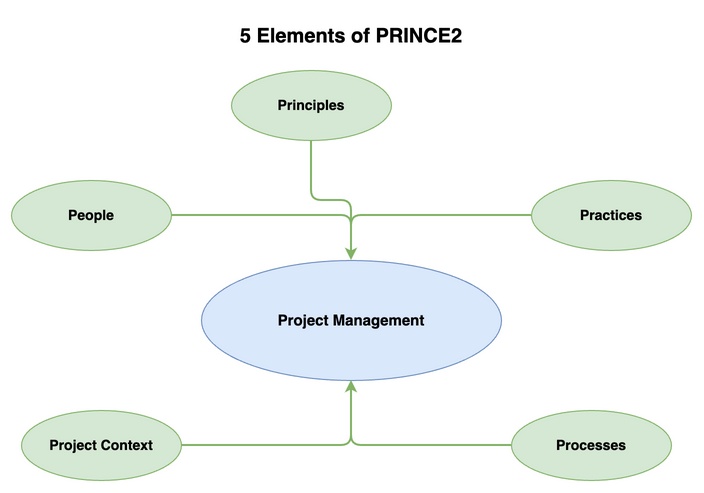
PRINCE2 is a project management method composed of five integrated elements. This is achieved by:
- Separating the management of the project from the specialist development activities, allowing specialist activities to be integrated into a controlled environment
- Focusing on what needs to be done to manage the project, rather than prescribing how work is done
- Requiring that the method is established specifically for the needs and context of the project by the way it is applied and tailored
The Five Integrated Elements
| Element | Description |
|---|---|
| PRINCE2 principles | Guiding obligations that determine whether the project is genuinely being managed using PRINCE2. There are seven principles, and unless all of them are applied, it is not a PRINCE2 project |
| People | Projects need people — those working on the project and those affected by it. Understanding their needs, capabilities, motivations, and relationships is crucial |
| PRINCE2 practices | Describe essential aspects of project management that must be applied consistently throughout the project lifecycle. The seven practices explain the specific treatment required for each aspect to be effective |
| PRINCE2 processes | The seven processes describe the entire project lifecycle, from activities before getting started, through the stages of project delivery, to the final act of project closure. Each process has checklists of recommended activities and related responsibilities |
| The project context | The principles, practices, and processes are applied by the people involved to ensure the method is fit for the project context |
Key message: The five integrated elements are designed to work together. The practices ensure that the principles are continually applied during the processes in a way that is specific to the project context and consider the relationships and requirements of people within the project team and those outside the project team.
What is a Project?
A key challenge that organizations face is balancing two competing needs:
- Business as usual: Maintaining current operations (profitability, service quality, customer relationships, etc.)
- Business change: Improving or transforming operations to survive and compete in the future
Definition: Project A temporary organization that is created for the purpose of delivering one or more business products according to an agreed business case.
Five Characteristics of a Project
| Characteristic | Description |
|---|---|
| Change | Projects are the means by which we introduce change |
| Temporary | Projects are temporary in nature — they have a defined start and end |
| Cross-functional | Involves a team of people with different skills working together to introduce change that impacts others outside the team |
| Unique | Every project is unique — different team, customer, supplier, product, location, or timeframe |
| Uncertainty | Projects are riskier than any operational aspects of an organization |
What is Project Management?
Definition: Project management Project management is the application of methods, tools, techniques, and competencies to enable the project to meet its objectives.
Definition: Performance target The project’s performance target sets the expected success level against which the management of the project will be judged. PRINCE2 includes performance targets for benefits, cost, time, quality, scope, sustainability, and risk.
Seven Performance Targets
| Performance Target | Key Question |
|---|---|
| Benefits | Why are we doing this, and who are we doing it for? What justifies the investment? |
| Costs | Is the project affordable? Will it stay within budget? |
| Time | When will the project start, when will key products be delivered, when will it finish? |
| Quality | Is what is delivered fit for purpose and as specified? |
| Scope | What will the project deliver? Is there agreement on what is included and excluded? |
| Sustainability | What is the environmental impact of the project work and products? |
| Risk | How much risk is the business prepared to take? |
The Project Context
PRINCE2 has been designed so it can work within any context including:
Organizational Context
| Role | Definition |
|---|---|
| Business | The organization that provides the project mandate and the structure within which the project is governed |
| User | The organization that will use the project products to gain the expected benefits — may be internal or external |
| Supplier | The organization that provides the expertise, people, and resources required to deliver the products — may be internal or external |
| Customer | Where there is a commercial relationship between the business and the supplier, the business is regarded as the customer |
Delivery Methods
| Method | Description |
|---|---|
| Linear-sequential | Each delivery step occurs in sequence, and the product is made available during or at the end of the project (e.g., construction projects) |
| Iterative-incremental | Requirements gathering, design, development/coding, and testing occur iteratively throughout the lifecycle — often referred to as an agile approach |
| Hybrid | Some project elements use a linear-sequential approach, while other elements use an iterative-incremental approach |
Features and Benefits of PRINCE2
| Feature | Description |
|---|---|
| Proven | Based on established and proven practice and governance for project management |
| Universal | Can be applied to any project, of any scale, and easily implemented alongside specialist, industry-specific models |
| Flexible | Can be tailored to meet the specific needs of the organizations involved |
| Common language and concepts | Widely recognized, providing a common vocabulary for all participants, encouraging consistency and the ability to reuse project assets |
| Outcome-focused | Ensures project participants focus on the viability of the project in relation to its business case objectives |
| Increased organizational maturity | Promotes learning from project experience and continual improvement in organizations |
| Part of an integrated suite | Designed to work with other PeopleCert guides on programme management, portfolio management, and risk management |
If you enjoyed this, leave a comment~