

Organizing
The purpose of the organizing practice is to define and establish the project’s structure of accountability and responsibilities (the ‘who’).
Projects are complex ecosystems comprising an ever-changing web of relationships. One of PRINCE2’s principles is that projects must define roles, responsibilities, and relationships within an organizational structure that engages with and represents the interests of business, user, and supplier communities.
Definition: Role The function assigned to a group or individual in a particular project. It is not the same as the position or job of a person outside of that project.
6.2.1 The Three Project Interests
| Stakeholder | Description |
|---|---|
| Business | Projects are created to meet a business need, which needs to be continuously justified as value for money throughout the lifetime of the project. PRINCE2 defines a project executive role to represent this viewpoint |
| User | The products of a project should provide benefits to a defined set of users. PRINCE2 defines a senior user role to represent user interests on the project |
| Supplier | Projects require people with the necessary skills and knowledge to collaborate to deliver the products. PRINCE2 defines a senior supplier role to represent supplier interests on the project |
The business, user, and supplier interests are brought together on the project board.
Definition: Project board Accountable to the business for the success of the project and has the authority to direct the project within the remit set by the business.
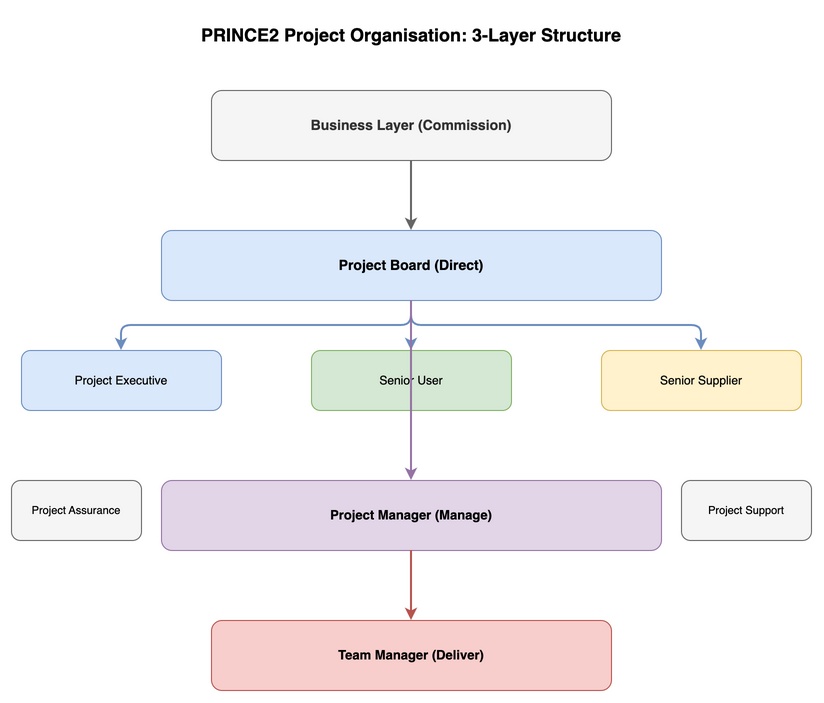
6.2.2 Four Organizational Levels
| Organizational Level | Role | Responsibilities |
|---|---|---|
| Commissioning (business layer) | Commissioning party within the business | Providing the project mandate, identifying the executive, defining the project level tolerances |
| Directing (project board) | Executive, senior user(s), senior supplier(s) | Accountable for project success, overall direction and management within constraints set by the business layer |
| Managing (project manager) | Project manager | Day-to-day management within constraints established by the project board |
| Delivering (team managers) | Team managers and team members | Day-to-day management and decision-making for their element of the project within constraints set by the project manager |
6.2.3 Project Management Team Structure
Definition: Project management team structure Composed of the project board, project manager, team managers, and project assurance and project support roles.
Definition: Project team PRINCE2 uses the term project team to cover all people required to allocate their time to the project.
6.2.4 PRINCE2 Roles
6.2.4.1 Project Executive
- Appointed by the business as the single point of accountability for the project; ultimately accountable for the success of the project (this accountability cannot be delegated)
- Secures funding for the project and is responsible for the business case and continued business justification
- There cannot be more than one project executive role, and the role cannot be combined with the project manager role
6.2.4.2 Senior User
- Represents the user community and is accountable for the approach to capture user requirements and specification of benefits aligned to the business case
- Responsible for:
- Ensuring the approach gains user buy-in to the project
- Monitoring the products against the requirements in line with the business case
- Demonstrating to the business that the forecasted benefits are on track to be realized
- Controlling change to requirements and benefits
- Successful handover and adoption of products into the business and continued realization of benefits after project closure
6.2.4.3 Senior Supplier
- Represents the supplier community involved in all aspects of delivering the project products
- Accountable for the quality of products delivered by suppliers and the technical integrity of the project
- Depending on the scale and complexity, more than one person may be required to represent the suppliers
6.2.4.4 Project Board
All PRINCE2 projects must have a project board comprising the project executive, senior user, and senior supplier roles.
Project board responsibilities:
- Having sufficient funding, people, and resources to deliver the project objectives
- Establishing clear feedback loops to support adapting and evolving the project
- Assuring all aspects of the project’s performance and products independently of the project manager
- Ensuring business strategy and objectives are reflected in the business case
- Setting stage tolerances to enable management by exception
- Focusing on the safety and well-being of the project team
- Monitoring and supporting social cohesion within the project ecosystem
6.2.4.5 Project Manager
- Responsible for day-to-day management of the project within constraints established by the project board
- Responsibilities include:
- Managing and, where appropriate, delegating the work to team managers or team members
- Setting work package tolerances and constraints for team managers and project support roles
- Ensuring decisions are being made in line with project board guidance and tolerances
- The responsibility of the project manager as a single focus means the role should not be shared or combined with other roles
6.2.4.6 Team Manager
- Responsible for delivering work allocated to them within tolerances and constraints agreed with the project manager
- Responsible for:
- Delivering the products to the agreed specifications
- Setting the tolerances and constraints for team members to work within
- Managing relationships both within their team and any interfaces with other teams, the project manager, project assurance, and project support
6.2.4.7 Project Assurance
- Project board members are accountable for the assurance of their respective areas (business assurance, user assurance, supplier assurance)
- Project assurance roles cannot be assigned to the project manager, team manager, project team members, nor project support
6.2.4.8 Project Support
- Responsible for providing services such as administrative support, facilitating meetings and workshops, advice and guidance on project tools, planning support, risk management, issue management, and change management
- Project support must be kept separate from project assurance roles to maintain the independence of assurance
6.2.5 Work Breakdown Structure
Definition: Work breakdown structure A hierarchy of all work to be done during a project that forms a link between the product breakdown structure and the work packages.
- Most useful when there are multiple work packages and particularly a mix of internally staffed and externally supplied work packages
- For a very simple project (such as delivery of just one work package with a small team), a work breakdown structure would not be required
6.3 Techniques
6.3.1 PRINCE2 Technique for Organizational Design and Development (5 Steps)
| Step | Description |
|---|---|
| 1. Understand the organizational ecosystem | Understand organizational structures and corporate governance requirements; clarify people management, governance, management approaches, and transitions |
| 2. Design the project ecosystem | Determine the effective team structure, people and resources needed, implement integrated working practices, develop project behaviours and culture |
| 3. Develop the project ecosystem | Implement the organizational design, adapting and evolving as the project progresses: onboarding, training, team building, succession planning |
| 4. Manage the ongoing changes to the project ecosystem | Make best use of people and resources; ensure a robust change management procedure is established |
| 5. Transition the project into the organizational ecosystem | At close, consider three key aspects: Products (accepted into business), People (transitioned back), Learning (lessons shared) |
6.3.2 Supporting Techniques
Delivery Models
The organizational and commercial arrangements to be deployed to meet the project objectives given the project constraints and capabilities of the user, business, and supplier organizations. It is described in the commercial management approach and reflected in the project management team structure.
- Range from thin client models (most project work undertaken by suppliers) to thick client models (most work undertaken by the business)
- The delivery model defines which aspects of project management will be in-house or external
RACI Chart
- Responsible (R): one or more people who perform the task
- Accountable (A): the single person who ‘owns’ the task
- Consulted (C): the people whose input is required for the task
- Informed (I): the people who are informed of progress or completion of the task
Benefits of a RACI chart: clarity of ownership, clear responsibility for delivery, stronger teamwork, visual format that reduces confusion and ensures there are no gaps
6.4 Applying the Practice
6.4.1 Organizational Context
- The programme and project management team structures and roles need to be integrated to ensure clear lines of responsibility and accountability from top to bottom, avoid duplication, and make reports and reviews efficient
- Integration of roles may include: programme manager as project executive, single programme office taking project support responsibilities for all projects
6.4.2 Commercial Context
- Where projects require multiple organizations to work together, there is a need to bridge between varied working practices and ways of governing across organizations
- Commercial context considerations include contract obligations, joint project board structures, supplier project boards, and appointing a prime contractor
6.4.3 Delivery Method
- The project manager needs to understand how roles prescribed by the delivery method align to PRINCE2 roles
- Iterative-incremental techniques often include the role of product owner, which could be aligned to the senior user role
- The use of management by exception is essential to enable the PRINCE2 method and iterative-incremental techniques to work together effectively
6.4.4 Sustainability
- The project management team structure and role descriptions should define responsibilities for delivering the sustainability targets
- The commercial management approach should ensure the way products are ethically procured and the performance measures enable meeting sustainability targets
6.4.5 Scale
- Large, complex projects: project management team structure could include breaking PRINCE2 roles into multiple appointments (several senior users or senior suppliers)
- Smaller, simpler projects: people may be assigned multiple roles as long as the separation from the project manager to the project executive and project assurance is observed
- Large projects may establish a change authority, distinct from the project manager, reporting to the project board
6.5 Management Product: Commercial Management Approach
The commercial management approach is part of the project initiation documentation.
Purpose: To describe the procedures, techniques, and standards to be applied and the responsibilities for effective commercial management
High-level content:
- Scope: description of the commercial relationships required
- Delivery model: description of delivery model for the project work
- Resources: for market engagement, procurement, and contract management activities
- Responsibilities: defines the responsibilities for market engagement, procurement, and contract management activities
- Supporting tools and techniques: for example, tender systems or contract management systems
- Standards: any standards that apply to market engagement, procurement, or contract management
- References: for any associated documents or products
If you enjoyed this, leave a comment~