A concise summary of the PRINCE2 Business Case practice, including benefits realization and investment appraisal techniques.
Business Case
The purpose of the business case practice is to establish mechanisms to judge whether the project is (and remains) desirable, viable, and achievable as a means to support decision-making in its continued investment.
Key Definitions
Term
Definition
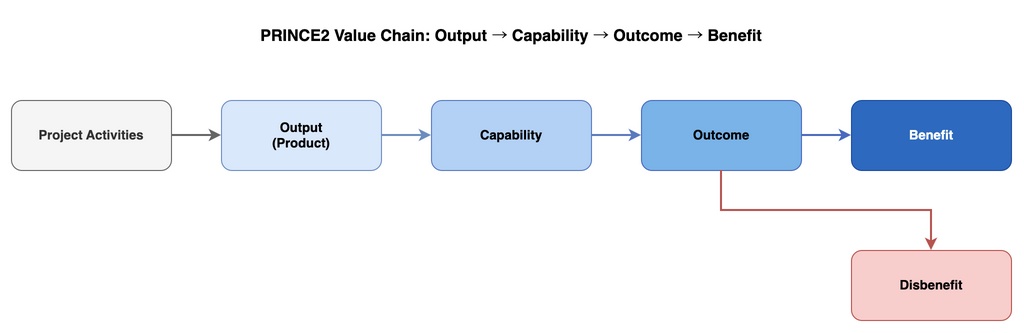
Output
The tangible or intangible deliverable of an activity. In PRINCE2, outputs are the specialist products that will be used to enable change
Capability
The completed set of project outputs required to deliver an outcome
Outcome
The result of change, normally affecting real-world behaviour and circumstances
Benefit
The measurable improvement resulting from an outcome that is perceived as an advantage by the investing organization and contributes towards one or more business objectives
Dis-benefit
The measurable decline resulting from an outcome perceived as negative by the investing organization and which detracts from one or more business objectives
Business objective
The measurable outcomes that demonstrate progress in relation to the organization’s strategy and to which the project should contribute
Benefits tolerance
The permissible deviation in the benefit performance targets that is allowed before the deviation needs to be escalated to the next level of management
Sustainability tolerance
The permissible deviation in the sustainability performance targets that is allowed before the deviation needs to be escalated to the next level of management
PRINCE2 Value Chain: Output → Capability → Outcome → Benefit
The business case establishes not only the reason for the project but also confirms whether the project is:
Desirable (the balance of costs, benefits, and risks)
Viable (able to deliver the products)
Achievable (whether use of the products is likely to result in envisaged outcomes and resulting benefits)
Business Case Lifecycle
Step
Description
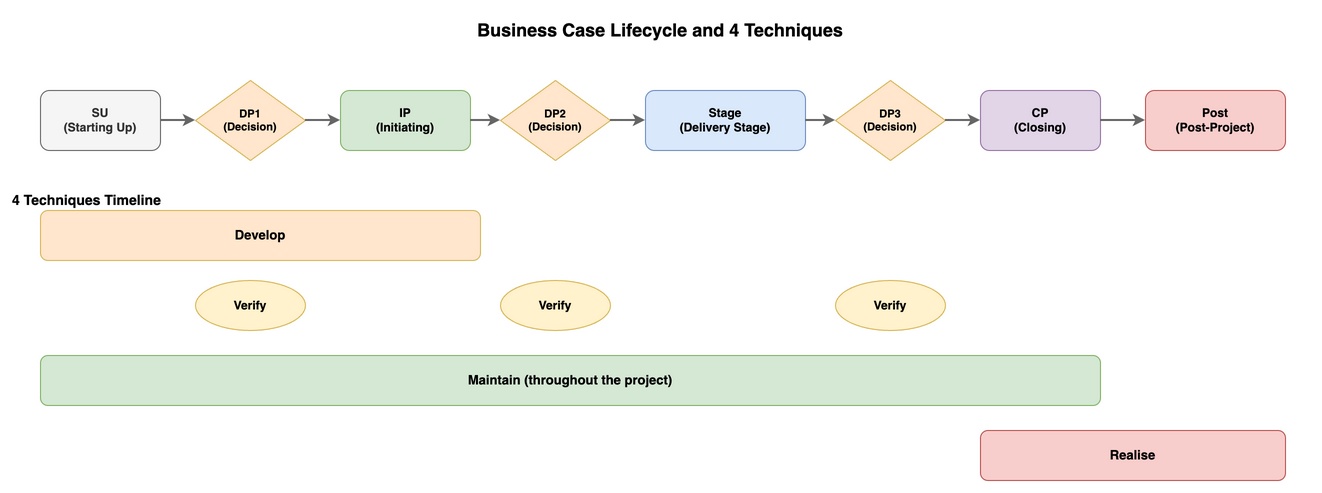
Develop
Explore options and get the right information upon which investment appraisal decisions can be made
Check
Assess whether the project is (still) worthwhile
Maintain
Keep the business case updated with actual progress and current forecasts (including forecast benefits)
Confirm
Assess whether the intended benefits have been (or will be) realized
Business Case Lifecycle and 4 Techniques
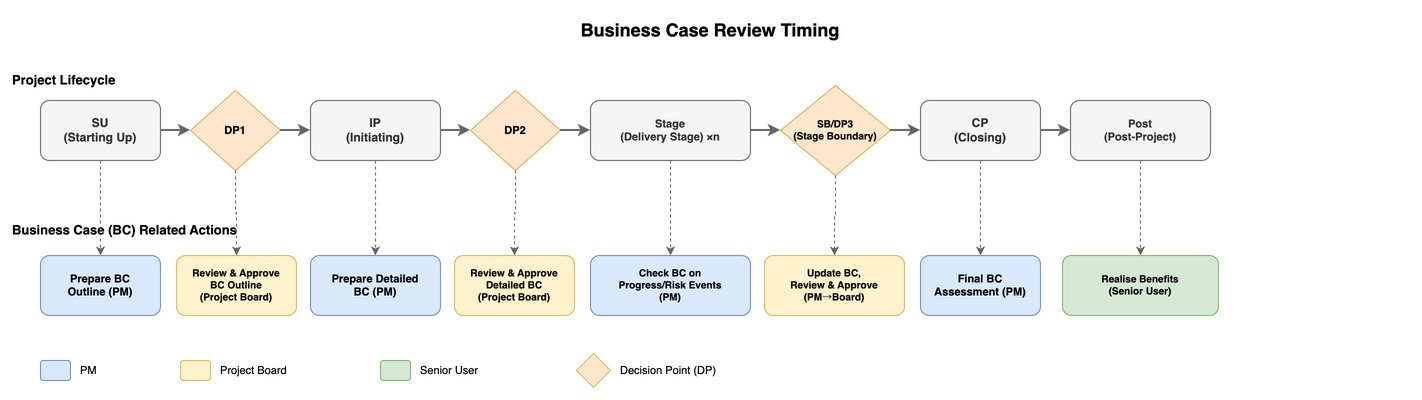
When the Project Board Checks the Business Case
At the end of the process of starting up a project to authorize project initiation
At the end of the process of initiating a project to authorize the project
At the end of each stage to authorize the next stage and the continuation of the project
When assessing an exception plan to authorize the revised stage and continuation of the project
Business Case Review Timing
Three Basic Business Options
Do nothing differently (always the first option; baseline for quantifying other options)
Do the minimum
Do more than the minimum
Supporting Techniques
Investment Appraisal
Technique
Description
Whole life costs
Analysing the total cost of implementation and any incremental transitional, operational, and maintenance costs
Net benefits
Analysing the total value of the benefits minus the cost of implementation, transition, and ongoing operation
Return on investment (ROI)
Profits or savings resulting from investments expressed as a percentage of the initial investment
Payback
A measure of time to remunerate the investment of cash and other resources
Net present value (NPV)
An amount of money that the investment will have earned by a particular point in time that considers the time value of money using a discount rate
Internal rate of return (IRR)
A percentage that indicates the rate of return on investment when the NPV is zero
Options analysis
A comparison of options by scoring each option against weighted assessment criteria
Sensitivity analysis
Adjusting the input factors to model the point at which the output factors no longer justify the investment
Multi-case Model
Perspective
Description
Strategic
Understanding the drivers for change and demonstrating how the investment provides strategic fit
Economic
Identifying the option that delivers best value, including wider social, environmental, and sustainability considerations
Financial
Assessing affordability, funding, budgeting, and cashflow over the life of the project and project product
Implementation and commercial
Showing that the preferred option can be delivered by service providers and that robust arrangements are established for successful project delivery
Best, Expected, and Worst-Case Scenarios (for iterative-incremental methods)
Scenario
Description
Best-case
Benefits expected when all must-have, should-have, and could-have requirements are delivered
Expected-case
Benefits expected when must-have and should-have requirements are delivered
Worst-case
Benefits expected when only must-have requirements are delivered (project must still be viable)
Management Products
Evolution of the Business Case
Project mandate → Project brief (outline BC) → Business case (full BC)
Project brief contents:
Project definition: Explains what the project should achieve (background, objectives, desired outcomes, scope, constraints, tolerances, users, interested parties)
Outline business case: Reasons why the project is needed and the business option selected
Project product description: Includes user quality expectations and acceptance criteria
Project approach: Defines the approach to deliver the selected business option
Project management team structure and role descriptions: Who will work on the project and with what scheme of delegation and reporting
References: For any associated documents or products
Sustainability
The United Nations defines 17 sustainability development goals to improve health and education, reduce inequality, and encourage economic growth while tackling climate change. The sustainability targets for the project must align with the organization’s broader objectives and any ESG targets it has defined.


If you enjoyed this, leave a comment~