

Managing Product Delivery
The purpose of the Managing Product Delivery process (MP) is to control the link between the Project Manager (PM) and Team Manager (TM). By agreeing on the requirements for accepting, executing, reporting on, and delivering specialist products, it ensures reliable delivery.
This process views the project from the Team Manager’s perspective (whereas Controlling a Stage views it from the Project Manager’s perspective).
Objectives
The following actions ensure delivery in accordance with quality and plan.
- Establishing agreement: Work assigned to the team is authorised and agreed
- Clear understanding: The team understands what to produce and the required effort, cost, and duration
- Adherence to quality and tolerances: Planned products meet expected quality and are delivered within tolerances
- Managing expectations: Accurate progress information is provided to the PM at agreed frequencies to enable appropriate expectation management
Context
Team Manager’s Approach
The TM manages product creation as team representative through the following steps.
-
Preparation and planning: A series of preparatory activities from WP agreement to work start
- Accepting the WP: Accept the Work Package (WP) authorised by the PM after agreeing on content
- Creating the Team Plan: Create a concrete Team Plan based on the WP (can be done in parallel with Stage Plan creation)
- Maintaining relationships: Maintain the connections between development, operations, and maintenance as defined in the WP Description
-
Development and quality management: Creating and quality-checking specialist products in accordance with specified methods
- Adhering to methods: Develop products in accordance with specified development methods
- Demonstrating quality: Prove that each product meets its specification using the quality methods defined in Product Descriptions
-
Delivery: Obtaining approval and handing over products to the PM
- Obtaining approval: Obtain formal approval from the designated approval authority for completed products
- Delivering products: Provide approved products to the PM in accordance with the procedures specified in the WP Description
Key Implementation Points
- Autonomy and avoiding micromanagement: Protect team productivity through appropriate delegation of authority to TMs
- Delegating authority: The PM grants sufficient autonomy to TMs based on tolerances and trust established in the WP Description
- Preventing side effects: PM micromanagement causes team frustration and delays — avoid it and keep focus on delivering the required outcomes
- PM perspective vs TM perspective: Both roles have different viewpoints with distinct areas of focus
- PM (Controlling a Stage): Oversees whether the stage as a whole is running well
- TM (Managing Product Delivery): Focuses on whether assigned products can be built on time and to quality
- Team Plan flexibility: Format can be chosen according to contract, scale, and complexity
- Simple cases: Adding a schedule to the WP Description may suffice
- Complex cases: A detailed structure similar to a Stage Plan
- Commercial cases: The WP itself may function as part of a contract
Key Outputs
| Output | Description |
|---|---|
| Team Plan | The execution plan created by the TM to complete the WP. Includes team structure, schedule, and working arrangements |
| Specialist Products | Expert products developed and delivered by the TM’s team |
| Checkpoint Report | Regular progress reports provided by the TM to the PM |
Activities
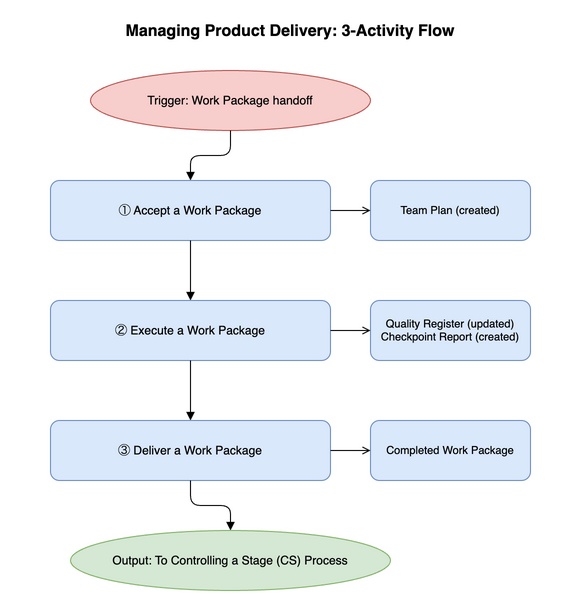
| Input | Activity | Output |
|---|---|---|
| WP authorisation (triggers this process), WP Description (review) | ① Accept a Work Package | Team Plan (created/updated) |
| Team Plan (review), WP Description (review) | ② Execute a Work Package | Project Log (updated), Specialist Products (created) |
| Team Plan (review), WP Description (review), Project Log (review) | ③ Review Work Package Status | Checkpoint Report (created each period), Project Log (updated) |
| Team Plan (confirm), WP Description (confirm), Project Log (review) | ④ Deliver a Work Package | Team Plan (updated), Work Package (completed), Notification of WP completion (triggers Controlling a Stage) |
Activity Details
① Accept a Work Package
Before work begins, this activity establishes complete agreement between the PM and TM on what will be delivered, constraints, procedures, and the validity of the plan.
Understanding content and creating the plan
- Understand the content: Review the WP Description to accurately grasp the product content and deadline
- Create the Team Plan: Create a concrete Team Plan that respects constraints (or fits within a timebox if using an agile approach)
- Confirm standards compliance: Consult with Project Assurance (Supplier) on whether the Team Plan is feasible and complies with supplier-side standards
Quality and log management
- Confirm quality arrangements: Consult with Project Assurance on whether additional quality reviewers are needed; update the Project Log (Quality Register, etc.)
- Confirm procedures: Check the WP Description to confirm procedures for updating the Project Log
Approval and risk assessment
- Obtain plan approval: Obtain necessary approvals for the Team Plan (where PM approval is inappropriate in a customer-supplier commercial relationship, the Senior Supplier reviews and approves)
- Review risks: Review risks based on the Team Plan; notify the PM of any newly identified risks, and if authorised, update the Project Log directly
- Final agreement: Once all conditions are met, formally agree to deliver the WP
② Execute a Work Package
Actually develop and monitor specialist products in accordance with the authorised WP requirements.
Key implementation points
- Autonomous management: The TM can independently perform work and take corrective action within established tolerances
- Forecast-based action: As long as the WP is forecast to complete within tolerance, the TM continues to control autonomously
- Reporting deviations: If the WP is forecast to exceed tolerances, the TM promptly raises the issue to the PM rather than acting unilaterally; subsequent action is decided by the PM
- Ensuring psychological safety: Maintaining an environment in which issues and risks are shared promptly without concealment is key to successful delivery
Recommended actions for the TM
- Manage development and report progress: Progress work as required and share events with the PM in a timely manner
- Adherence to requirements: Lead the team so that products are built correctly in accordance with the WP Description and Team Plan
- Feedback information: Notify the PM of any newly identified issues, risks, or lessons; ensure PM-directed actions are carried out
- Quality management and record updates: Record and report the completion of quality activities and product approval status
- Report quality activity completion: Notify the PM each time planned quality activities are completed; keep the Quality Register up to date
- Approval and registration: Obtain formal approval from approval authorities for completed products; update product status in the Product Register
③ Review Work Package Status
The TM reviews WP progress at the frequency defined in the WP Description and reports the status to the PM.
Key operational points
- Multi-faceted review: Confirm all aspects of the WP — not just schedule progress, but also quality, risks, issues, and lessons — to ensure information accuracy
- Supplier-specific management: In commercial situations where the TM belongs to a supplier organisation, evaluation may use proprietary management tools and registers separate from the overall project log
- Using Project Support: The Project Support role may extract and provide WP-related information from the overall project log to assist the TM’s review work
Recommended actions
- Review status: Comprehensively check all logs and registers before reporting to grasp the full picture of the WP
- Compare with plan: Review the WP Description and Team Plan; compare expected progress with actuals
- Check logs: Review the Issue Register, Risk Register, and Lessons Log; organise events affecting the WP
- Check quality and products: Review the Quality Register (activity status) and Product Register (completion status including approval records)
- Report status: Communicate the understood situation to the PM by the defined means
- Formal report: Summarise the understood status in a Checkpoint Report and deliver to the PM
- Pull system: When using agile methods, instead of sending reports, maintain an environment in which the PM can directly view progress charts such as kanban boards and burn-down charts
④ Deliver a Work Package
Formally notify the PM that all work in the WP has been completed and all products have been approved, and carry out the handover.
Key operational points
- Assuring quality: This is not simply a report that work has finished — it substantiates that defined quality standards have been met and necessary approvals obtained
- Sharing exceptions: Clearly communicate any remaining risks or off-specifications at completion so the PM can make the next decision (while all finishing perfectly is the ideal, some approvals may have been given with minor deficiencies noted; it is important to highlight such unresolved issues and risks rather than concealing them)
Recommended actions for the TM
- Deliver products and verify: Hand over products using prescribed procedures and verify that all approvals are complete
- Deliver using prescribed procedures: Provide completed products to the PM in accordance with the procedures agreed in the WP Description
- Final verification of approvals: Review approval records to confirm that all products delivered by the WP have been appropriately approved
- Update records and review: Update the Team Plan and Project Log to record the completion state
- Complete the Team Plan: Update the plan to record that the WP has been formally completed
- Comprehensive log review: Review the Project Log (Risk Register, Issue Register, Lessons Log); organise any unresolved items and knowledge gained related to the WP
- Report to PM and issue final notification: Formally notify WP completion after explaining performance and remaining items
- Explain performance: Describe to the PM how actual work performance (duration, cost, quality, etc.) compared with what was agreed in the WP Description
- Highlight remaining items: Emphasise to the PM any unresolved issues (such as off-specifications) related to the completed products and any risks that remain
- Formal completion notification: After the above confirmation, formally notify the PM of WP completion
Applying the Process
General Considerations
Management that maximises specialist expertise and respects team autonomy is recommended.
- Flexible activity execution: Activities can be combined, split, or run concurrently to suit the situation, but a reliable connection with the Controlling a Stage process must always be maintained
- Management suited to specialist methods: Specialist work uses delivery methods (such as agile) and measures appropriate to its type; the PM and TM agree on these and reflect them in WP Descriptions, aligning with the overall project management approach
- WP hierarchy and governance: WPs are not necessarily small. For large WPs, the TM may further divide them into smaller WPs and assign them to team members, building an appropriate control environment
- Collaborative culture: The relationship between TM and team members should be collaborative. Rather than simply issuing orders, the TM acts as a facilitator promoting member ownership and supporting contribution to project goals
Tailoring Roles
The management structure can be flexibly configured according to organisational scale and complexity.
- TM role and delegation: The TM bears responsibility for all process activities, but the PM can take on the TM role
- TM hierarchy: For large projects, WPs can be split across multiple TMs with reporting lines arranged hierarchically. In this case, the senior TM bears overall responsibility and reports to the PM
- WP Description flexibility: Who creates, updates, and approves the WP Description can be changed flexibly according to project needs, as long as the PM and TM have agreed on the content
Responsibilities
| Activity | Business Layer | Project Executive | Senior User | Senior Supplier | Project Manager | Team Manager | Project Assurance | Project Support |
|---|---|---|---|---|---|---|---|---|
| ① Accept a Work Package | — | — | — | — | A | R | — | I |
| ② Execute a Work Package | — | — | — | — | A | R | C | C |
| ③ Review Work Package Status | — | — | — | — | A | R | C | C |
| ④ Deliver a Work Package | — | — | — | — | A | R | C | I |
R = Responsible, A = Accountable, C = Consulted, I = Informed
Applying Practices to the Process
| Practice | Application to Managing Product Delivery |
|---|---|
| Business Case | Ensure that requirements related to benefits and sustainability defined in the WP Description are fulfilled during the execution process |
| Organising | Comply with communication, change, and commercial management requirements. Create a Team Plan recording team structure and work schedule; continuously monitor team wellbeing |
| Plans | Create a concrete Team Plan to complete the WP, based on requests from the PM |
| Quality | Develop and deliver specialist products meeting WP quality requirements. Update the Quality Register to record planned activities and actuals |
| Risk | Manage risks at team level; keep the Risk Register current. Escalate to the PM as needed |
| Issues | Manage issues at team level; keep the Issue Register current. Escalate to the PM as needed |
| Progress | Update the Product Register based on product status. Submit Checkpoint Reports at agreed frequencies; update the Lessons Log with findings |
Comparison with Other Frameworks
| Concept | PRINCE2 | PMBOK | PgMP |
|---|---|---|---|
| Process positioning | Managing Product Delivery (MP) | Direct and Manage Project Work | (TBD) |
| Unit of work | Work Package | Work Package (lowest WBS level) | Component |
| Team-level planning | Team Plan | (WBS decomposition, activity list) | Component Plan |
| Progress reporting | Checkpoint Report | Work Performance Data & Reports | (TBD) |
If you enjoyed this, leave a comment~