

Quality
The purpose of the quality practice is to document the user’s requirements of the project products and to establish the means by which they will be met.
Quality is concerned with ensuring that the project products meet the user’s requirements and expectations and enable the desired benefits to be realized.
Definition: Quality The degree to which a set of inherent characteristics of a product, service, process, person, organization, system, or resource fulfils its requirements.
Quality should be built into everything; not just tested at the end of the project.
8.1 Key Quality Terminology
| Term | Definition |
|---|---|
| User’s quality expectations | A statement about the quality expected from the project product, captured in the project product description |
| Requirement | A need or expectation that is documented in an approved management product. Captured and documented needs or expectations are requirements and constitute part of the project scope |
| Acceptance criteria | A prioritized list of criteria that the project product must meet before the user will accept it. For example, measurable definitions of the attributes required for the set of products to be acceptable to key stakeholders |
| Quality specifications | A description of the quality measures that will be applied by those performing quality control and the levels that a finished product must meet |
8.1.2 Product-Based Quality
The principle of focusing on products is central to the PRINCE2 approach to quality:
- Aims to translate requirements into acceptance criteria and quality specifications for project products and the activities to deliver them
- Ensures clear traceability of quality specifications and quality controls to the required products
- It is easier and cheaper to correct quality issues and flaws early in the project lifecycle rather than when the finished product is being tested or already in operational use
8.2 Guidance for Effective Quality Management
Quality management focuses on three elements: quality planning, quality control, and quality assurance.
| Element | Involves |
|---|---|
| Quality planning | Identifying major products and documenting in the project product description; eliciting user requirements and detailing in quality specifications in product descriptions; developing the quality management approach; obtaining the project board’s approval as a baseline |
| Quality control | Implementing the agreed quality management approach during delivery; assessing issues related to quality and raising quality exceptions when necessary; obtaining acceptance of the delivered products |
| Quality assurance | Ensuring that the quality planning and control techniques are sufficient to confirm that the quality requirements can be met |
8.2.1 Quality Planning
Definition: Quality planning The capturing of quality specifications for the project products and generating the associated product descriptions and quality management approach.
Quality planning steps:
- User’s quality expectations: Documented in the process of starting up a project in the project product description; should identify all major products, quality expectations and acceptance criteria, applicable standards and procedures, measurements, quality tolerances
- Quality tolerances: Projects rarely have sufficient resources to meet all quality specifications and acceptance criteria, so prioritization is necessary
- Describing products: High-level requirements must be developed in further detail via product descriptions to enable realistic planning, estimating, scheduling, and quality control
- Product sustainability: Product descriptions should include sustainability requirements captured as quality specifications or acceptance criteria
Definition: Product description A description of a product’s purpose, format, composition, where it is derived from, quality specifications, and development responsibilities.
Quality responsibilities (specified in product description):
- Producer: The person or group responsible for developing a product
- Reviewer: The person or group responsible for assessing if a product meets its quality or acceptance criteria (reviewers should always be independent of producers to avoid a conflict of interest)
- Acceptance authority: The person or group responsible for deciding if a product is acceptable
Definition: Product register A component of the project log that identifies the products to be delivered by the project and records their acceptance.
8.2.2 Quality Control
Definition: Quality control The procedures to monitor the specific products of a project and their development or delivery activities to determine whether they comply with relevant standards and of identifying ways to minimize causes of unsatisfactory performance.
Definition: Quality register A component of the project log that identifies all the quality control activities that are planned or have occurred and provides information for end stage reports and the end project report.
The quality register provides a record of quality control activities, starting with the approval of each product description.
8.2.3 Quality Assurance
Definition: Quality assurance A planned and systematic activity that provides confidence that products will meet their defined quality specifications when tested under quality control. Quality assurance activities are typically performed by the business ensuring they are independent of the project team.
Important distinction:
- Quality assurance: focused on products, independent of the project management team; typically performed by a function from the business
- Project assurance: the responsibility of the project board; used to confirm if the project is being conducted correctly; independent of the project manager but not the project
8.3 Techniques
8.3.1 PRINCE2 Technique for Quality Management (Three Steps)
Quality planning → Quality control → Accepting products
     ↑                                      ↓
(Project product          (Product register updated)
 description)                               ↑
     ↓                          (Quality register records)
(Product descriptions,
 Quality management approach)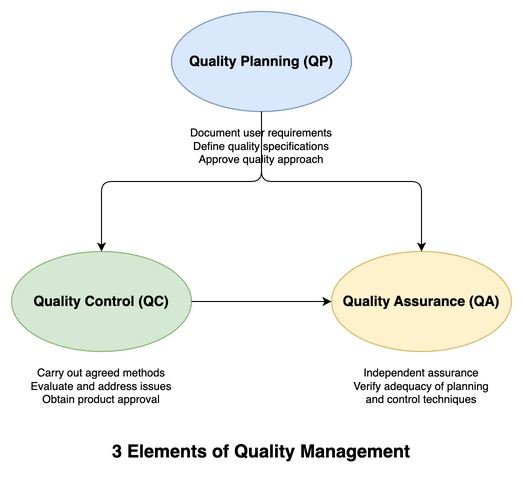
Planning quality creates two management products:
- Product descriptions: detailing the quality specifications for each product and associated quality tolerances
- Quality management approach: describing the supporting techniques and standards to be applied, and the roles and responsibilities for achieving the required quality specifications and acceptance criteria
Creating product descriptions — key points:
- Quantitative measures: translating requirements into numeric terms (e.g., 100 staff is a quantitative measure)
- Qualitative measures: translating requirements into descriptive rather than numeric terms such as ‘easy to use’ — risk that they can be too vague to assess objectively
- Functional requirements: describes how a product must perform and be used
- Non-functional requirements: describes inherent characteristics of the product, such as its security or reliability
8.3.2 Supporting Techniques (Quality Technique Types)
| Quality Technique | Description |
|---|---|
| Verification | Focuses on confirming that interim products (such as the project design) reflect the necessary quality specifications and acceptance criteria and on ensuring that the delivery method follows good practices; occurs during the design and development of a product before the actual product exists |
| Validation | Focuses on confirming that the product meets the quality specifications and acceptance criteria; occurs during testing or after the product exists |
| Prototyping | Produces an interim product used to obtain early feedback on its functionality or to understand full scale production concerns; integral to iterative-incremental delivery methods; sometimes referred to as beta testing |
| Testing | Involves the use of the product, its components, or some portion of its functionality under conditions representative of its intended use; can occur at multiple times during development and delivery |
| Inspection | Confirms that the product complies with quality specifications and acceptance criteria; usually occurs at the point of delivery; most applicable to commodities and commercial off-the-shelf products |
| Certification | Presentation of proof that the product or supplier complies with applicable industry or regulatory requirements; usually occurs at the point of delivery and requires the lowest level of effort |
8.4 Applying the Practice
8.4.1 Organizational Context
- Identify whether the business or programme has a mandated quality management system and expertise to perform quality assurance activities
- The project may also be subject to external quality standards (e.g., when the project is within a regulated environment)
- Where the project is part of a programme or portfolio, the quality management approach for the programme will usually determine the project’s quality management approach
8.4.2 Commercial Context
- Product descriptions and the quality management approach must consider the function of a contract or other commercial agreement during product delivery
- Access to a supplier’s facility or the ability to conduct inspections or independent tests should be specified as part of the contract terms
- Care should be taken to ensure that contractual quality and acceptance criteria do not conflict with those in the product and project product descriptions
8.4.3 Delivery Method
Linear-sequential projects:
- More information about the required products and their delivery activities available, enabling product descriptions and quality specifications to be developed in sufficient detail
- Acceptance criteria and quality specifications may be affected by changes external to the project, addressed through change control
Iterative-incremental projects:
- Quality specifications and acceptance criteria are not fixed with the approval of the project initiation documentation; considered goals to be achieved through iterations of development and delivery (sprints)
- Project product descriptions may be written in the form of high-level user stories with associated acceptance criteria
- An agile project may aim for early delivery of a minimum viable product; quality management approach may include a standard ‘definition of done’ and ‘definition of ready’
8.4.4 Sustainability
Sustainability requirements should address:
- The organization’s ability to sustain expected benefits after delivery (product sustainability)
- The organization’s ability to achieve its expectations for the environmental impacts of the project and its products (environmental sustainability)
8.4.5 Scale
Quality management always has a cost:
- Projects with few products delivered through well-understood methods: may rely on existing standards and inspection at the point of delivery
- Projects developing new products with numerous components or subsystems and multi-stage delivery: may need significant investment in quality control and numerous quality reviews (e.g., technical design inspections, unit tests, integration tests, performance tests, functional tests, and user acceptance testing)
8.5 Management Products
Product Description
Purpose: To describe a product’s purpose, composition, where it is derived from, and quality specifications
High-level content: Identifier, version, purpose, composition, format, derived from, quality specifications, development or production approach and skills required, allocated to, quality tolerance, quality methods and quality skills required, responsibilities
Quality Management Approach
Purpose: To describe the quality techniques and standards to be applied and the roles and responsibilities for achieving the required quality specifications and acceptance criteria during a project
High-level content: Scope, quality management procedures, responsibilities, resources, supporting tools and techniques, standards, references
Quality Register
Purpose: To summarize all quality management activities that are planned or have occurred
High-level content: Quality identifier, product identifier, quality method, dates, responsibilities, result (pass/fail), records
Product Register
Purpose: To list all products required of a plan and the status of those products
High-level content: Product identifier, dates (product description approval date and product acceptance date), status (such as in development or accepted), references
If you enjoyed this, leave a comment~