

Introduction to PRINCE2 Practices
The PRINCE2 practices describe aspects of project management that must be continually addressed as the project progresses through its lifecycle. The strength of PRINCE2 is the way in which the seven practices are integrated, both in how they link together and are used across all the PRINCE2 processes.
Definition: Practice An aspect of project management that must be applied consistently and throughout the project lifecycle. The practices require specific treatment of that aspect of project management for the PRINCE2 processes to be effective.
The Seven PRINCE2 Practices
| Practice | Description | Answers the Question | Chapter |
|---|---|---|---|
| Business case | The project starts with an idea that is considered to have potential value for the organization. This practice addresses how the idea is developed into a viable investment proposition and how success is defined and verified. It provides the basis for how project management maintains focus on the project’s benefits, purpose and alignment with the objectives and priorities of the business | Why? | 5 |
| Organizing | Project work needs to be directed by those accountable, delegated to those responsible to manage it, and allocated to those who will deliver the products required of the project. This practice describes the roles, responsibilities, and relationships in the temporary PRINCE2 project management team | Who? | 6 |
| Plans | PRINCE2 projects are delivered in stages based on a series of approved plans. This practice complements the quality practice by describing how plans are designed and developed. Plans are matched to the needs of the people through the project management layers | How? How much? When? | 7 |
| Quality | The initial project idea will only be understood as a broad outline. This practice explains how the outline is developed so all stakeholders understand the quality attributes of the products to be delivered | What? | 8 |
| Risk | Due to the unique nature of projects, which use new and different products, suppliers, and/or procedures, there is more uncertainty which will result in more risk. This practice addresses how the project team manages uncertainty | What if? | 9 |
| Issues | This practice describes how project management assesses and responds to issues that have a potential impact on any aspect of the project. Issues may be unanticipated general problems, requests for change, or instances of a product not meeting its specification | What now? | 10 |
| Progress | This practice addresses the ongoing achievability of the plans. It explains the monitoring of performance and the escalation process if events do not go according to plan. Ultimately, this practice determines whether and how the project should proceed | Where are we now? Where are we going? Should we carry on? | 11 |
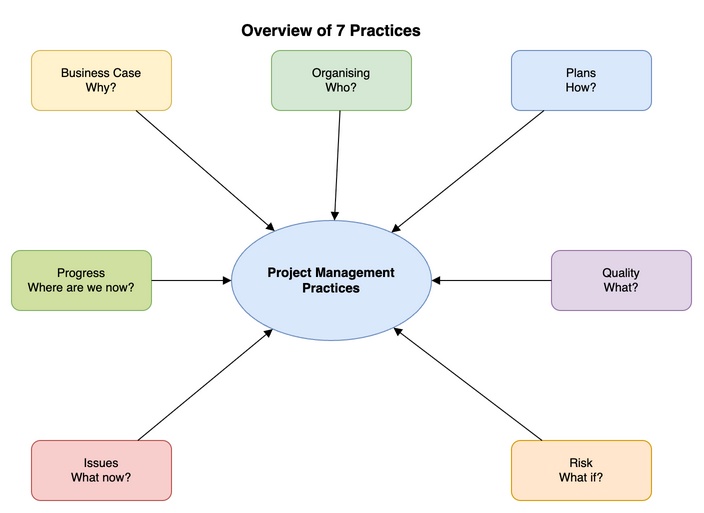
Applying the Practices
- It is expected that the PRINCE2 method will be applied and tailored to ensure it is fit for purpose for the project’s context
- All seven practices should be applied in a project; however, they vary according to the scale, risk, the people and organizations involved, and the complexity or simplicity of the project
- PRINCE2 practices are designed to help the project management team apply and tailor the method, principally through a suite of management approaches
Management Products
Project Initiation Documentation (PID)
The PID comprises the package of information developed and compiled during initiation to gain authorization to proceed with the project.
Three primary uses:
- Ensure that the project has a sound basis before asking the project board to make any major commitment to the project
- Act as a base document against which the project board and project manager can assess progress, issues, and ongoing viability questions
- Provide a single source of reference about the project so that people joining the ‘temporary organization’ can quickly and easily discover what the project is about and how it is being managed
High-level content:
- Project definition: Explains what the project needs to achieve (background, objectives, desired outcomes, scope, constraints, assumptions)
- Project approach: Defines the choice of solution and delivery method
- Business case: Describes the justification for the project based on estimated costs, risks, and benefits
- Project management team structure: A chart showing who will be involved with the project
- Role descriptions: Describe the roles of those in the project management team
- Management approaches: The procedures, techniques, and standards for: change management, benefits management, commercial management, communication management, data management, issue management, quality management, risk management, and sustainability management
- Project plan: Describes how and when the project’s objectives are to be achieved
- Tailoring of PRINCE2: A summary of how PRINCE2 is tailored for the project
Project Log
The project log maintains a live record of project activities and progress.
Contains:
- Issue register
- Lessons log
- Product register
- Quality register
- Risk register
- Daily log of other information actions and events
Format of Practice Chapters
Each practice chapter is structured as follows:
- Purpose of the practice
- Guidance for effective use and management of the practice
- Techniques that support the practice (PRINCE2-specific + additional context-dependent techniques)
- Applying the practice
- Management products to support the practice
- Focus of key roles for the practice
- Key relationships with the PRINCE2 principles
If you enjoyed this, leave a comment~