

Issues
The purpose of the PRINCE2 issue practice is to capture and assess issues and control changes to project baselines.
Projects are undertaken in an ever-changing organisational and environmental context. The broader the scope and the longer the duration, the more likely issues and changes will need to be addressed. Issue management is central to project monitoring; handling information without filtering (censoring) is the key to maintaining the ability to respond to change.
Core Definitions
| Term | Definition |
|---|---|
| Issue | A project-related event that requires project management attention. Raised by team members or stakeholders at any time and recorded in the project log |
| Change | A modification to approved products that form the project baseline. Not incorporated into the baseline until approved by an individual or role with appropriate authority |
| Project baseline | The current approved version of management products and project products subject to change control |
- Avoid prejudging: Do not judge whether an issue is good or bad before it has been assessed.
- Attitude to change: Change is not something to be avoided; it is inevitable in all projects. What is important is addressing it in a responsive, controlled manner.
Issue Management Framework (Guidance)
The Issue Management Approach consists of the following components.
- Baseline: A clear definition of the products and documents subject to change control.
- Issue resolution: Procedures to identify, capture, and assess issues and propose the best solutions.
- Change control: Description of how modifications and changes to the project baseline are managed and controlled.
- Delegated authority for change: Decision-making authority allocated by the Project Board to specific individuals or roles to enable rapid, controlled responses.
- Change budget: Funds reserved during planning to respond to anticipated changes and issues.
1. Baseline
Assessing the impact of a change requires a baseline approved by the Project Board.
- Visibility of changes: A new version is created each time a change is approved and implemented. Change control allows tracking of when changes were made and who authorised them.
- Things to define: Regardless of project scale, the team must define:
- Level of baselining: Break down products to the level at which they can be released or modified independently.
- Identification method: Establish a system to assign unique identifiers (IDs) to each product.
- Information to record: Decide what information (version, status, dependencies with other products) to maintain in the project log.
- Approval authority: Clarify the specific authority and approval flow required for baselining.
- Integrity verification: Regularly verify that the actual state of products matches their approved state. Typically conducted at the end of each stage or at project end.
2. Issue Resolution
All issues should be properly categorised and assessed, providing valuable data to identify which aspects of project management are not functioning as intended.
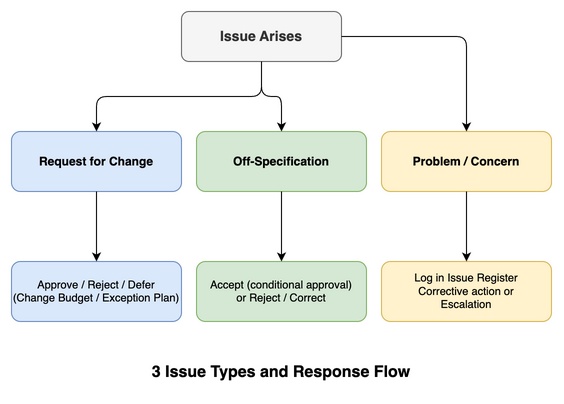
- Issue categorisation: Issues are categorised as one of the following:
- Problem: An issue with an immediate negative impact.
- Concern: An event whose timeliness and impact should be assessed.
- External event: An event occurring in the project’s external environment that may affect the project.
- Business opportunity: An event bringing unexpected positive outcomes for the project or user organisation.
- Distinction from risk: When assessing an issue, confirm whether it is an uncertain event (risk) or an already-occurred event (issue). If uncertainty remains, transfer it to the Risk Register for management.
- Recording and analysis:
- Issue Register: Record all issues.
- Issue Report: Created when detailed analysis is needed; summarises type, impact on baseline, and recommended resolution.
3. Change Control
Identify and assess changes that may affect the project baseline, and decide to approve, reject, or defer them.
- Request for Change (RFC): A specific proposal to change the baseline. Must identify the target management product and provide justification for the change.
- Off-specification: A product that fails to meet quality specifications (expected functionality or standards). Must always be processed through change control procedures.
- Concession: An off-specification that the Project Board accepts as is without requiring corrective action.
4. Delegated Authority for Change
Final authority for reviewing and approving requests for change and off-specifications rests with the Project Board.
- Too little delegation: The Project Board must be consulted for trivial change decisions, causing delays and stalling progress.
- Too much delegation: When authority is spread too widely, alignment with business justification is lost and overall project benefits are at risk.
- Change authority: Appointing change authorities at multiple levels within the project management team, depending on project scale and complexity, prevents unnecessary escalation.
5. Change Budget
- Form of change budget: Usually refers to funds specifically reserved for managing changes, but may be defined as authorised constraints that can be traded off depending on circumstances.
- Pairing authority and budget: The Project Manager must confirm that delegated authority for change is accompanied by an appropriate change budget sufficient to actually implement those changes.
5-Step Issue Management Technique
Issue management is carried out using the following standard 5-step technique.
- Capture: Identify the issue, understand its content accurately, and record it in the Issue Register or Issue Report.
- Assess: Analyse the impact of the issue on the project’s business objectives, schedule, cost, quality, and risk.
- Propose: Consider multiple solutions and summarise the one with the best cost-benefit balance as a recommendation.
- Decide: The person with appropriate authority decides to approve, reject, or defer the proposed solution.
- Implement: Execute the actions based on the decision. This may include updating the baseline and modifying or adding work packages.
Assessing an Issue
When reviewing an issue, identify its type and clarify the specific impact on the project.
- Integrated assessment perspective: A comprehensive assessment is needed that considers impacts on approved targets and tolerances, the Business Case, and dependencies with other products.
- Trade-off consideration: This includes considering trade-offs such as improving quality in exchange for schedule delays, and the possibility of concessions.
Deciding on a Change
| Type | Response | Considerations |
|---|---|---|
| Request for Change | Approve | Identify the source of change funding (use change budget, reduce other scope, or request additional funding) |
| Request for Change | Reject | Confirm that rejecting the change maintains business justification and expected benefits remain achievable |
| Request for Change | Request Exception Plan | Appropriate when the issue stems from quality specifications being too stringent and can be resolved by changing approved tolerances |
| Request for Change | Request further information | Defer the decision and seek further analysis when the impact of approval or rejection is complex |
| Off-specification | Accept | Assess impact on business justification. Update the baseline and record as a concession |
| Off-specification | Reject | Consider solutions (use change budget, submit Exception Plan, contractual remedies) |
Supporting Techniques
- Root Cause Analysis (RCA): Decompose the problem into components to identify the true root cause rather than surface symptoms.
- Pareto analysis (80/20 rule): Based on the principle that 80% of outcomes result from 20% of causes; identify the most impactful causes as a priority.
- Cause-and-effect analysis (Fishbone diagram): Classify important factors by category and organise visually.
- Failure Mode and Effects Analysis (FMEA): Enumerate all possible failures in products or processes and evaluate their consequences. Effective when prototypes exist.
- 5 Whys: Explore the deeper root of a problem by repeatedly asking “Why?”. A simple tool usable even without statistical data.
Management Products Supporting the Practice
Issue Management Approach (part of Project Initiation Documentation)
- Purpose: Describe how issues will be captured and reported, and explain how changes to the project baseline will be assessed and controlled.
- High-level content:
- Scope: Description of the scope of the Issue Management Approach
- Project baseline elements: List of management products that form the project baseline
- Issue reporting and resolution procedures: Description of how issues are raised, reported, and resolved
- Change control procedures: How changes to the project baseline are requested, decided on, incorporated, and verified
- Change budget: Authorised change budget and allocation at stage or work package level
- Responsibilities: Responsibilities related to the Issue Management Approach, including delegation of change authorities
Issue Register (part of the Project Log)
- Purpose: Capture all Issue Reports raised during the project lifecycle, their current status, and closure date.
- High-level content:
- Issue identifier: Unique reference code for the issue
- Issue type: Problem, concern, external event, business opportunity, request for change, off-specification
- Severity: Priority and severity assessment
- Status: Current status of the issue (logged, reviewed, actioned, etc.)
- Decision: Record of the decision taken to respond to the issue
Issue Report
- Purpose: Describe the impact of the issue on the project baseline, identify how to resolve the issue, and recommend a decision.
- High-level content:
- Description: Summary of the issue’s factors, causes, and impact
- Impact analysis: Analysis of the impact on the project baseline
- Options: Ways in which the project, user, or supplier can respond to the issue
- Recommendation: The decision recommended by the Project Manager or Team Manager
Key Roles and Responsibilities
| Role | Key responsibilities |
|---|---|
| Business Layer | Provide business layer policies, standards, and procedures for issue management and change control. Approve project-level change budget (if used). Respond to escalated issues |
| Project Executive | Determine whether a project-level change budget is needed and its amount. Set stage-level change budget. Approve the Issue Management Approach. Make decisions on escalated issues with emphasis on continued business justification |
| Senior User | Make decisions on escalated issues with emphasis on protecting expected benefits. Agree to the Issue Management Approach |
| Senior Supplier | Make decisions on escalated issues with emphasis on protecting the integrity of the overall solution. Agree to the Issue Management Approach |
| Project Manager | Prepare and maintain the Issue Management Approach in consultation with stakeholders. Manage issue and change control procedures. Maintain the Issue Register. Implement corrective actions |
| Team Manager | Implement issue and change control procedures agreed in the Work Package Description. Implement corrective actions |
| Project Assurance | Advise the Project Manager on the Issue Management Approach. Confirm to the Project Board that the Issue Management Approach complies with business policies |
| Project Support | Maintain the Issue Register, maintain project baselines, and assist the Project Manager in creating Issue Reports |
Key Relationships with Principles
| Principle | How achieved | Result |
|---|---|---|
| Ensure continued business justification | Ensure issues and changes are assessed in terms of impact on the Business Case and project justification | Issues and changes are addressed while keeping the project aligned with overall business strategy |
| Focus on products | Link issues and requested changes to the project baseline | Clear traceability of changes and linkage to products is ensured |
| Manage by exception | Establish issue management authority and procedures | Efficient means for the Project Manager to manage issues, make decisions, and report exceptions within the authority delegated by the Project Board |
| Tailor to suit the project | Require only the level of change control appropriate to the project’s importance, complexity, chosen delivery method, and product characteristics | Appropriate balance between control and responsiveness |
Comparison with Other Frameworks
| Concept | PRINCE2 | PMBOK | PgMP |
|---|---|---|---|
| Issue/change management documents | Issue Management Approach, Issue Register, Issue Report | Change Management Plan, Change Log | (TBD) |
| Types of change | Request for Change, off-specification, problem/concern, external event, business opportunity | Change requests (including corrective actions, preventive actions, defect repair, updates) | (TBD) |
| Change approval authority | Project Board (may delegate to change authority) | Change Control Board (CCB) | (TBD) |
If you enjoyed this, leave a comment~