

Processes Overview
A process is a structured set of activities designed to accomplish a specific objective, defining the inputs, outputs, and sequence of actions involved. PRINCE2 processes contain the activities necessary to direct, manage, and deliver a project effectively.
The 7 Processes
PRINCE2 has seven processes.
| Process | Abbreviation | Main Actors | Purpose |
|---|---|---|---|
| Starting up a Project | SU | Project Manager, Business | Confirm viability |
| Directing a Project | DP | Project Board | Project Board decision-making |
| Initiating a Project | IP | Project Manager | Detailed planning and baseline establishment |
| Controlling a Stage | CS | Project Manager | Day-to-day management by the Project Manager |
| Managing Product Delivery | MP | Team Manager | Product creation and reporting by the team |
| Managing a Stage Boundary | SB | Project Manager | Preparation for the next stage |
| Closing a Project | CP | Project Manager | Formal closure procedures |
- Minimum stage structure: Regardless of project size, there are always at least two stages on the timeline: the initiation stage and the final stage. Depending on scale and need, one or more intermediate stages may be inserted between them.
Process Overview Map
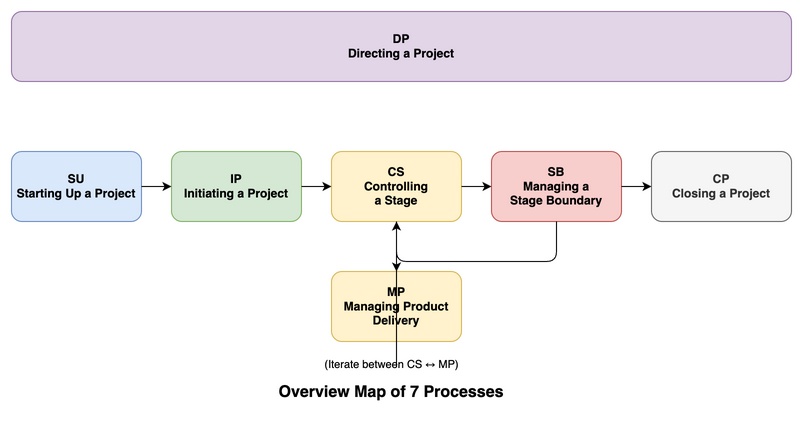
Project Lifecycle
Before the Project Starts
Before a project formally begins, a preparatory phase is needed to shape the idea or need and confirm its feasibility.
- Project mandate (trigger): The trigger for the project. Provided by the Business (the organisation commissioning the project). The form can range from a verbal instruction to a formally defined document.
- Starting up a Project (SU) process: Before formally starting the project, confirms whether it is worthwhile and viable.
- Key activities: Appoint the Project Manager and Project Board, create the Project Brief, create the Stage Plan (for the initiation stage).
- Directing a Project (DP) process: The Project Board reviews the Project Brief and Stage Plan and decides whether to authorise the project to proceed.
Initiation Stage
The stage following approval to start the project, in which detailed plans are developed and management controls established.
- Initiating a Project (IP) process: Establishes key foundations for project success:
- Detailed planning: Clarify schedules and resources.
- Governance setup: Define project management approaches and controls.
- Business Case development: Develop a robust Business Case underpinning investment justification.
- Benefits management: Determine how benefits delivered by the project will be reviewed.
- Preparing for the next stage: In the latter part of the initiation stage, use the Managing a Stage Boundary (SB) process to prepare detailed plans for the next stage.
- Stage end and authorisation: The Project Board uses the Directing a Project (DP) process to decide whether to authorise the overall project and the next stage. The approved PID (Project Initiation Documentation) is saved as a baseline for evaluating future progress.
Subsequent Stages
From the initiation stage onward, the project progresses through one or more delivery stages. Day-to-day management, product creation, and stage transitions are the focus.
- Controlling a Stage (CS) process: The Project Board delegates day-to-day management to the Project Manager on a stage-by-stage basis.
- Project Manager responsibilities: Continuously verify that the project is progressing according to the approved plan and that forecasts remain within tolerances.
- Board reporting: The Project Manager submits Highlight Reports regularly to keep the Project Board informed.
- Managing Product Delivery (MP) process: Manages interactions between the Project Manager and Team Managers (or team members).
- Work assignment: The Project Manager assigns work as Work Packages (WPs).
- Team reporting: Teams report progress to the Project Manager via Checkpoint Reports.
- Managing a Stage Boundary (SB) process: The process of closing the current stage and preparing for the next at the end of each stage.
- Performance reporting and authorisation request: The Project Manager reports on the current stage and requests permission to proceed.
- Planning and update: Creates detailed plans for the next stage and updates the Business Case based on the current situation.
- Board decision: The Project Board assesses continued viability aligned with business strategy and decides whether to authorise the next stage.
Final Stage
Since a project is a temporary undertaking, a formal closure process is required at the end of the final stage.
- Closing a Project (CP) process: Performs the following activities:
- Product transfer and ownership confirmation: Confirm that recipients of project products can own and continue to use them.
- Performance evaluation: Evaluate the project’s final performance against the original plan.
- Resource release: Release personnel and resources assigned to the project.
- Document archiving: Archive project-related documents appropriately for future reference and audit.
- Benefit review plan confirmation: Confirm or revise plans to review benefits that emerge after project completion.
After the Project
Even after the project is formally closed, activities to confirm value realisation continue.
- Benefits realisation: Most benefits are realised in the operational phase after project completion.
- Role of the Benefits Management Approach: The timing and method of benefit reviews, and who is accountable and responsible for them, must be documented.
Components of a Process Description
Each process is described using the following structure:
| Component | Content |
|---|---|
| Purpose | The reason for executing the process |
| Objectives | The specific goals to be achieved by the process |
| Context | The relationship with other processes; input/output management products |
| Activities | The recommended sequence of actions |
| Responsibilities | Role assignments defined by a RACI table |
Comparison with Other Frameworks
| Concept | PRINCE2 | PMBOK | PgMP |
|---|---|---|---|
| Total number of processes | 7 processes | 5 process groups (49 processes) | (TBD) |
| Day-to-day management processes | Controlling a Stage (CS), Managing Product Delivery (MP) | Executing Process Group, Monitoring & Controlling Process Group | (TBD) |
| Project closure process | Closing a Project (CP) | Project Closure | (TBD) |
If you enjoyed this, leave a comment~