

Starting up a Project
The purpose of the Starting up a Project process is to confirm that the prerequisites for initiating a project are established by answering the question: “Is this project viable and worthwhile?”
This process acts as a gatekeeper before full-scale initiation — confirming that the essential conditions are in place.
- Sound judgement: Prevents poorly thought-out ideas from being initiated
- Efficiency: A lightweight process that assesses viability with minimum effort, compared to the more thorough Initiating a Project process
- Foundation-setting: No work should begin until roles and responsibilities are assigned and the basis for detailed planning is established
Objectives
Aims to confirm and establish the following.
- There is a business justification for the project (documented in the Business Case outline)
- All necessary authority exists to start the project (assigning people and securing resources)
- Sufficient information is available (in the form of a Project Brief) to define and confirm the project scope
- Alternative approaches have been evaluated and the selected project approach has been agreed
- At least one of the following has been appointed: those to carry out the work in the initiation stage, or those to take on key project management roles
- A work plan has been developed for the initiation stage (documented in a Stage Plan)
- The project scope, duration, acceptance criteria, and constraints are not based on vague assumptions
Context
Trigger: Project Mandate
The trigger for the project before it formally starts is called a project mandate.
- Provided by: An authority figure in the Business Layer (outside the project) — such as an executive group, programme, portfolio, or customer
- Content: Various forms, such as feasibility studies or requests for proposals
- Minimum information: At least enough information to identify a candidate Project Executive
- Development: This mandate information is elaborated into the Project Brief
Key Implementation Points
- Iterative work: Preparing the Business Case outline and assembling the Project Brief are done in parallel and iteratively
- Frequent communication: Close, regular interaction is needed between the PM and stakeholders such as the Project Board
- Programme context: When the project is part of a programme, much of the work (providing the brief, appointing members) may be done by the programme, greatly reducing work in this process
- Early investment benefit: Clearly understanding requirements at this stage avoids issues, exceptions, and plan revisions during delivery, saving significant time overall
Key Outputs
| Output | Content |
|---|---|
| Project Brief | Document summarising the project definition, approach, and roles |
| Business Case outline | The rationale demonstrating the project’s justification |
| Stage Plan (for the initiation stage) | The plan defining what will be done in the next step: the initiation stage |
Activities
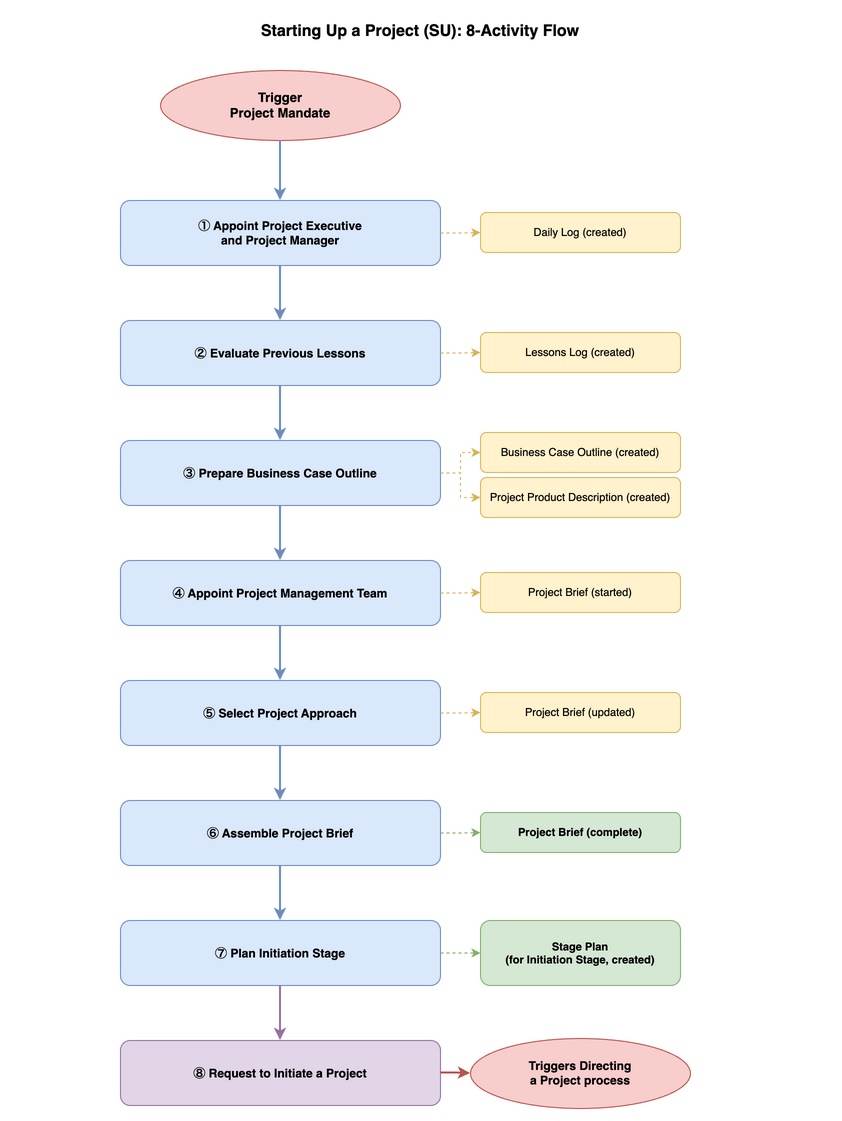
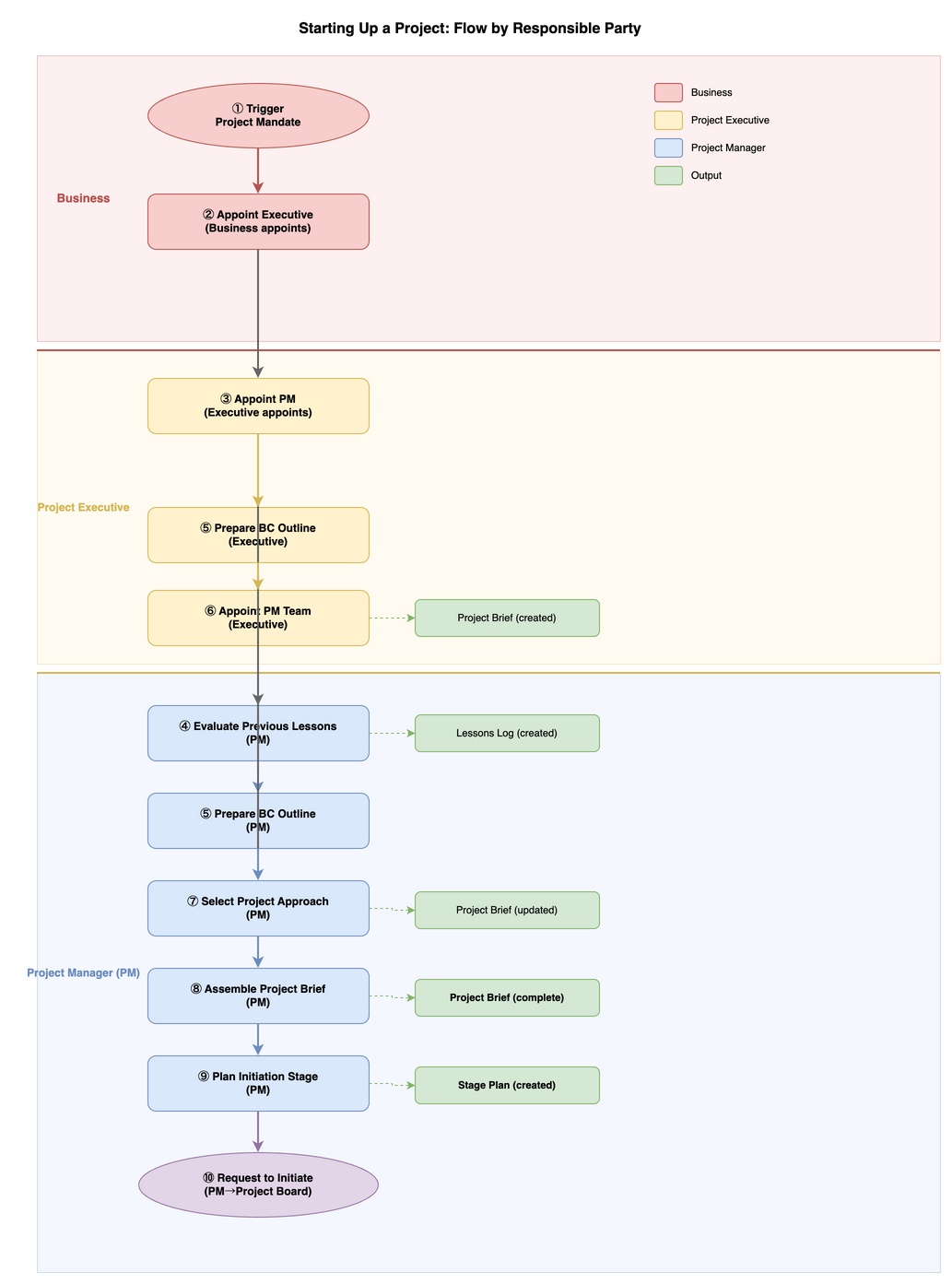
| Input | Activity | Output |
|---|---|---|
| Project mandate (trigger), Previous Lessons Report (review) | ① Appoint the Executive and the Project Manager | Daily Log (created) |
| Project mandate (trigger), Previous Lessons Report (review) | ② Evaluate previous lessons | Lessons Log (created) |
| Project mandate (trigger), Previous Lessons Report (review) | ③ Prepare the Business Case outline | Project Product Description (created), Business Case outline (created) |
| Project mandate (trigger), Previous Lessons Report (review) | ④ Appoint the project management team | Project Brief (created) |
| Project mandate (trigger), Previous Lessons Report (review) | ⑤ Select the project approach | Project Brief (created) |
| Project mandate (trigger), Previous Lessons Report (review) | ⑥ Assemble the Project Brief | Project Brief (created) |
| Project mandate (trigger), Previous Lessons Report (review) | ⑦ Plan the initiation stage | Stage Plan (created for initiation stage) |
| Project mandate (trigger), Previous Lessons Report (review) | ⑧ Request to initiate a project | Request to initiate (triggers the Directing a Project process) |
Activity Details
① Appoint the Executive and the Project Manager
A decision-maker with appropriate authority (the Project Executive) and a day-to-day manager (the PM) must be established early to move the project forward.
Roles:
- Project Executive: Represents the interests of all business stakeholders and is responsible for ensuring the project’s justification. Appointing the Executive is a prerequisite for starting the project.
- Project Manager (PM): Manages the day-to-day running of the project on behalf of the Executive. Appointing the PM puts management activities in motion.
Recommended actions:
- Review the project mandate (Business): Confirm understanding and clarify ambiguities
- Identify and appoint the Project Executive (Business): Select an appropriately authorised person and formally appoint them
- Identify and appoint the PM (Project Executive): Select the PM to whom day-to-day responsibilities will be delegated (consulting with the business as necessary)
- Create the Daily Log (PM): The PM creates the Daily Log as the first repository for project information
② Evaluate Previous Lessons
Apply knowledge gained from past projects (both internal and external) to building the foundations of this project.
What lessons cover and how they are used:
- Lessons content: Process strengths and weaknesses, procedures, techniques, and tools used — when, how, and by whom
- Applications: Reflect past lessons in the following:
- Project management team structure
- Business Case outline
- Project Brief
- Stage Plan for the initiation stage
Recommended actions for the PM:
- Review relevant lessons: Review audits and review reports from similar past projects; identify applicable lessons
- Conduct interviews: Have direct conversations with individuals and teams who worked on similar projects
- Create the Lessons Log: Create a Lessons Log to record identified lessons and their corresponding actions
③ Prepare the Business Case Outline
At this stage, information is limited, so the Business Case remains a high-level outline rather than a detailed document.
This outline serves as the basis for agreement when developing the detailed Business Case during the initiation process.
Recommended actions:
- Create the Business Case outline (Project Executive): Based on the project mandate and current information; consult with Senior Users if appointed
- Define the product (PM): Work with the Project Executive, Senior Users, and Senior Suppliers to define what the project should deliver — captured in the Project Product Description
- Identify key risks (PM): Review risks recorded in the Daily Log and include major risks that materially affect the project’s viability in the Business Case outline
④ Appoint the Project Management Team
Placing people with the right authority, responsibility, and knowledge is essential for rapid decision-making in the project.
Principles of team formation:
- Reflect all interests: Include representatives of business, user, and supplier interests
- Collaborative structure: Not just authority and knowledge — members must be able to work together to form a high-performing team
- Clear accountability and reporting: Everyone in the project management team must agree on who is accountable to whom, who is responsible for what, and how reporting and communications are structured
Recommended actions:
- Organisational design and role definitions (PM): Review the Lessons Log and design the team structure; prepare role descriptions to clarify responsibilities
- Team identification and appointment (Project Executive): Consult with Senior Users and the PM; formally appoint selected members
- Agree working practices and manage risks (PM): Agree team working practices (how the team will operate) and communication methods for the initiation stage; add any new risks to the Project Log
⑤ Select the Project Approach
Before beginning planning, determine the strategic direction for how the project will be executed.
This choice forms the basis for subsequent management approaches and progress controls.
Key questions to consider:
| Question | Options |
|---|---|
| Delivery model | Develop in-house or outsource to a third party |
| Build method | Adapt or reuse existing products, or build from scratch |
| Product nature | Base on commercial off-the-shelf (COTS) products, or bespoke development |
| Delivery approach | Iterative and incremental (agile) or linear and sequential (waterfall) |
| Sustainability | How the chosen approach supports and meets sustainability expectations and requirements |
Recommended actions for the PM:
- Determine the optimal approach: Evaluate delivery options and decide the most effective approach for delivering the product and realising the Business Case
- Define tailoring requirements: Define how standard management practices will be tailored to the project’s scale and context
- Record risks: Log any new issues or risks identified during deliberation in the Project Log
⑥ Assemble the Project Brief
Provides a clearly defined starting point for the project, based on shared understanding among all stakeholders.
Recommended actions for the PM:
| Item | Content |
|---|---|
| Confirm status and background | Confirm the project background and preparatory work carried out to date |
| Define objectives and outcomes | Clarify the goals to achieve and the desired final outcomes |
| Set scope and limits | Confirm the project scope, exclusions, and tolerances |
| Identify assumptions and constraints | Identify conditions that constrain the project and assumptions upon which it is based |
| Identify stakeholders and review structure | Identify known stakeholders including users; review the project management team structure and role descriptions |
| Identify dependencies | Identify interdependencies with other projects or ongoing activities |
| Documentand record risks | Consolidate all information into the Project Brief; record new issues and risks in the Project Log |
⑦ Plan the Initiation Stage
The initiation stage requires time and resources. Work must be planned and approved to ensure an organised start rather than an undirected one.
Recommended actions for the PM:
- Determine management controls: Based on the project approach, decide the management controls appropriate for the activities in the initiation stage
- Create the Stage Plan: Identify time and cost constraints and create the Stage Plan for the initiation stage using appropriate principles and techniques
- Evaluate risks and update the Log: Review risks in the Project Log and assess their impact on the initiation stage plan; update the log if new risks are identified or existing ones change
⑧ Request to Initiate a Project
The formal step that concludes the Starting up a Project process and initiates the transition to the full initiation phase.
Reporting to the Project Board:
The PM presents the products created so far and requests the Project Board to authorise the project’s initiation.
- Present justification: Present the Business Case outline and Project Brief, and explain the rational basis for starting the project
Recommended actions for the PM:
- Explain key matters: Provide the Project Board with details of:
- Business Case outline: Investment justification and rationale
- Project products: What will be delivered
- Project approach: How the project will be executed
- Project management team appointments: Who bears responsibility
- Initiation stage activities and controls: What will be done in the next stage and how it will be managed
- Formally request authority and resources: Formally request the Project Board’s authorisation to start the project and confirm resource allocation
Applying the Process
General Considerations
Focus on securing genuine project justification rather than being bound by formality.
- Flexible activities: The activities in this process can be combined, split, or run concurrently as appropriate. However, ensure the interface with the Directing a Project process is complete (all necessary information is in place) when making the request to initiate.
- Handling uncertainty: In the early stages, project outputs may not be clear. Even so, at minimum, what business problem will be solved or what outcome is sought must be defined clearly.
- Co-creation with stakeholders: Rather than the PM creating the Business Case outline, Project Brief, and initiation Stage Plan alone, developing them together with future users and stakeholders deepens understanding and buy-in.
Tailoring Roles
Role assignments can be adjusted flexibly to suit the organisation, but accountability must not be ambiguous.
- Timing of PM appointment: Early PM appointment is best practice
- Acting arrangements: If the PM has not been appointed until later in the process, the Project Executive (or their nominee) may create the necessary management products
- Delegation and accountability: The Project Executive need not personally create the Business Case outline — they may delegate. However, ultimate accountability always remains with the role’s designated owner.
Responsibilities
| Activity | Business Layer | Project Executive | Senior User | Senior Supplier | Project Manager | Team Manager | Project Assurance | Project Support |
|---|---|---|---|---|---|---|---|---|
| ① Appoint the Executive and the PM | A/R¹ | R | ||||||
| ② Evaluate previous lessons | C | A | R | |||||
| ③ Prepare the Business Case outline | C | A/R | C³ | C³ | R | |||
| ④ Appoint the project management team | A | R | ||||||
| ⑤ Select the project approach | A | C | C | R | C² | C | ||
| ⑥ Assemble the Project Brief | A | C | C | R | C | C | ||
| ⑦ Plan the initiation stage | A | C | C | R | I² | C | C | |
| ⑧ Request to initiate a project | A | C | C | R | I² | C | I |
R = Responsible, A = Accountable, C = Consulted, I = Informed
- A/R¹: The Business is accountable for appointing the Executive and the PM. The Business is also responsible for appointing the Project Executive.
- C²/I²: If Team Managers are identified when designing and appointing the project management team, it is good practice to consult them on the project approach and inform them of key details of the initiation stage plan if they are involved in that stage.
- C³: If appointed.
Applying Practices to the Process
| Practice | Application to Starting up a Project |
|---|---|
| Business Case | Based on the project mandate, lessons, and stakeholder consultations, a Business Case outline is created and forms part of the Project Brief |
| Organising | The Executive and PM are appointed by the Business; the necessary team structure is designed and people are assigned to the roles required for initiation |
| Plans | Key milestones are included in the Project Brief. The project approach (delivery method, etc.) is decided and a dedicated Stage Plan (covering duration, cost, and work content) is created for the initiation stage |
| Quality | User quality expectations and known standards are recorded in the Project Product Description; these are progressively refined in later processes |
| Risk | High-level risks that are known are identified and incorporated into the Project Brief |
| Issues | High-level issues that are known are identified and incorporated into the Project Brief |
| Progress | The project’s provisional tolerances are identified; the tolerances for the initiation stage itself are set in the Stage Plan |
Comparison with Other Frameworks
| Concept | PRINCE2 | PMBOK | PgMP |
|---|---|---|---|
| Process positioning | Starting up a Project (SU) | Develop Project Charter | (TBD) |
| Project trigger | Project mandate | Project charter | (TBD) |
| Initial document | Project Brief | Project Charter | (TBD) |
| Business justification | Business Case outline | Business Case | (TBD) |
If you enjoyed this, leave a comment~